


By Emmanuel Oloniruha
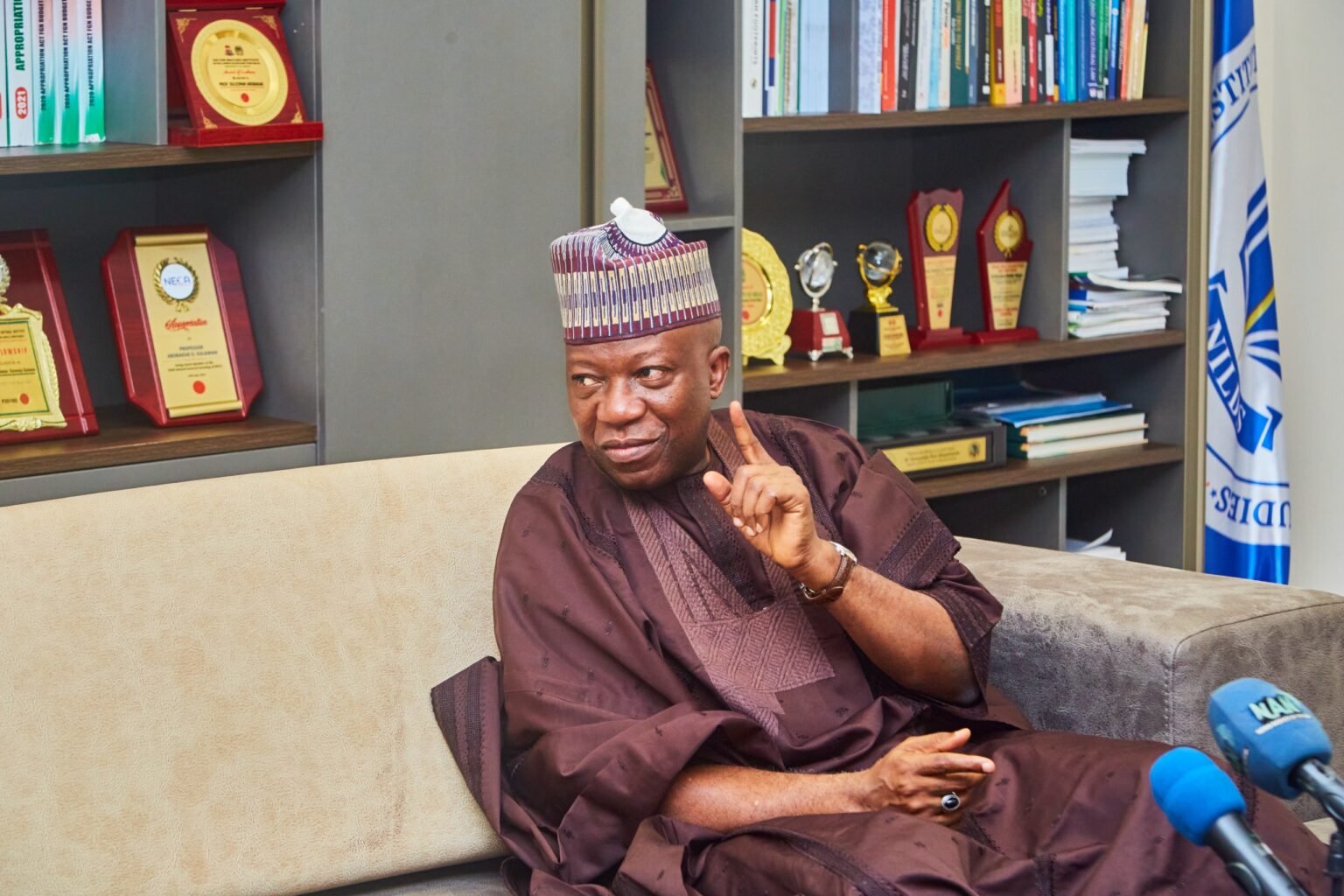
Director-General of National Institute for Legislative and Democratic Studies (NILDS), Prof. Abubakar Sulaiman, says the institute has extended its capacity-building and legislative support services to 31 state Houses of Assembly across Nigeria.
Sulaiman disclosed this while featuring on the News Agency of Nigeria (NAN) Personality Interview Series on Sunday in Abuja, while outlining the institute’s achievements and strategic focus over the past seven years.
The director-general said that when he took over the leadership of the institute, top among his priorities was how to strengthen democratic governance at the grassroots in Nigeria.
He said that top among his initial priorities upon assuming office was the need to decentralise legislative training and technical assistance, which had previously been concentrated on the National Assembly.
“Under the previous administration, we had a lot of concentrations on the National Assembly. For instance, state Houses of Assembly were not carried along.
“Democracy is not built at the top. Democracy should be bottom to the top, not the other way.
“Most of the state assemblies were not captured in the activities of the institute. Sub-national parliamentary capacities were not well-enhanced,’’ he said.
Sulaiman said that upon assumption of office, his objectives were to correct the perception that state legislatures were mere appendages of the executive arm of government by equipping them with the requisite technical capacities and skills.
“How do we incorporate state assemblies into what we do through training, capacity building, dialogue sessions, motion drafting and technical assistance?
“I want to say, with all sense of pride, that in the last seven years, we have worked with about 31 state assemblies.
“As at last week, all the members of Adamawa State Assembly were here (NILDS) for a three-day training.
“Through our partner, Konrad-Adenauer-Stifung (KAS), a German-based NGO, we entered into a kind of Memorandum of Understanding (MOU), initially with 16 states.
“On our own, we had to extend such collaboration with other states, making almost 31 to 32 states,’’ he said.
Sulaiman further stated that under his leadership, the institute had broadened its capacity-building service beyond the state legislature to other critical democratic institutions at the state level.
He listed entities such as Lagos State Law Reform Commission, telecommunications giant, MTN and Central Bank of Nigeria (CBN) as having engaged the institute for specialised capacity-development programmes.
“We’ve traversed all sectors in our training programme, in our capacity programme, in our services to people. Today, our institute is a leading research institution,’’ he added.
Noting the growth of the institute’s operations, Sulaiman disclosed that the NILDS training department conducted nearly 60 different training sessions in 2025 alone.
He added that in spite of being an election year with usually low patronage, the institute had executed more than 32 training sessions in 2026.
“Aside from the normal routine work of researchers liaising with the national assembly and state assemblies, and the academic department running certification courses, the training department alone has achieved remarkable coverage,” Sulaiman noted.
He said that the institute had also prioritised deepening democracy by promoting inclusivity in the areas of gender and youth inclusion in government.
According to him, NILDS has an existing collaboration with not less than 60 national and international non-governmental organisations (NGOs) and civil society organisations (CSOs), including KAS, the UN Women and Yiaga Africa.
“The institute has become an intellectual hub for other West African parliaments,’’ he remarked.
The director-general reiterated the institute’s commitment to providing research briefs, data analysis and policy interventions on critical national issues, including electoral reform, security and social inclusivity.(NAN)(www.nannews.ng)
OBE/FEO/WAS
=======
Edited by Francis Onyeukwu/’Wale Sadeeq
Comments