


By Kelu Musa
Mr Akwaowo Idongesit, the Acting Registrar and Chief Executive Officer, Institute of Chartered Chemists of Nigeria (ICCON), has said the institute will strengthen its professional licence verification process for chemical transactions to curb diversion and misuse.
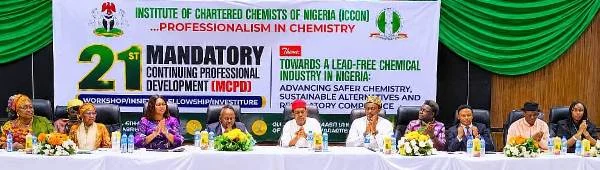
The News Agency of Nigeria (NAN) reports that Idongesit stated this at the institute’s 21st Mandatory Continuing Professional Development (MCPD) Workshop, Induction and Fellowship Investiture in Abuja.
The two-day event held from Nov. 4 to 5 with the theme, “Towards a Lead-Free Chemical Industry in Nigeria: Advancing Safer Chemistry, Sustainable Alternatives and Regulatory Compliance”.
Idongesit said as part of the institute’s expanding national security and chemical safety mandate, it was prioritising stricter monitoring of the chemical supply chain through several initiatives.
According to him, ICCON is intensifying its regulatory measures to strengthen licence checks across chemical transactions.
Idongesit said the initiative would be implemented in collaboration with relevant authorities, including the National Counter Terrorism Centre under the Office of the National Security Adviser (ONSA).
According to him, ICCON anticipates a transition within six months from reliance on its certificates to a verification process requiring practitioners’ current professional standing and valid practising licences for End-User Certificates (EUCs).
“Our objective is to ensure that professional accountability is firmly established and that current practising licences, alongside other applicable documentation, are recognised in the relevant processes,” Idongesit said.
According to him the initiative would help curb the diversion and misuse of controlled or sensitive chemicals without obstructing legitimate chemical commerce.
He said the institute would intensify stakeholder sensitisation, national chemical personnel audits, capacity building and enforcement to address gaps in professional chemical practice.
He explained that the Regulatory Framework for the Practice of Chemistry, gazetted in 2025, became effective in June 2026 as an instrument for enforcing professional standards.
“Our resolve is to ensure that individuals undertaking professional chemistry functions possess the requisite qualifications, professional registration and, where applicable, valid practising licences,” he said.
According to him, the institute’s regulatory drive is not intended to frustrate legitimate businesses but to promote a safer and more professionally accountable chemical sector.
Idongesit said lead exposure remained a serious public health concern, particularly for children and other vulnerable populations, requiring collective action by chemists, regulators, manufacturers and chemical handlers.
He said the institute was also working towards structured specialised training in chemical safety, good laboratory practice, quality management, hazardous waste management and sustainable chemistry.
In her remarks, the Permanent Secretary, Federal Ministry of Health and Social Welfare, Daju Kachollom, commended ICCON for its contributions to chemical sciences, public health, industrial growth and environmental sustainability.
Kachollom, who was represented by Dr Olufowobi-Yusuf Ademola, Director, Food and Drug Services in the ministry, said the ministry would continue supporting the institute towards achieving a safer and more sustainable chemical industry.
“Over the years, the Institute has played a vital role in ensuring that chemical sciences and chemical practice contribute meaningfully to national development, public health, industrial growth and environmental sustainability,” she said.
According to Kachollom, the MCPD programme provides chemists with opportunities to update their knowledge and keep abreast of emerging developments and ethical standards in the profession.
In her keynote address, Dr Fortune Ihua-Maduenyi called on scientists to develop research and affordable testing solutions to address lead exposure and other chemical-related hazards.
She also urged industries to adopt safer practices, and ensure effective engagement of community members in order to report suspected exposure and and al well ensure measures to protect children.
Ihua-Maduenyi said economic development must not come at the expense of human health, particularly among vulnerable communities.
While declaring the workshop open, the Minister of State for Health and Social Welfare, Dr Iziaq Salako, commended ICCON for sustaining its professional development programme.
Salako, who was represented by Mr Fatai Olaruwaju, Director, Chemicals Management Programme in the ministry, said chemists have important roles in ensuring safe chemical management, strengthening quality assurance and promoting compliance with established standards.
He urged ICCON and its members to provide the technical expertise needed to advance a safer and more sustainable chemical industry.
In his goodwill message, the President of the Chemical Society of Nigeria, Rufus Sha’ato, called for stronger collaboration between ICCON and the society to improve the transition from academic training to professional practice.
Sha’ato who was represented by the President-elect of the Society, Dr Ebritimi Berezi, urged ICCON to seek an amendment to its enabling laws to play a stronger role in accrediting chemistry departments in tertiary institutions.
He also advocated mandatory ICCON registration for persons occupying leadership positions in university chemistry departments.
The event was attended by chemists and other stakeholders from relevant government agencies and professional bodies.(NAN)
Edited by Joshua Olomu



Comments