


By Okon Okon
Experts on Wednesday in Abuja called for stronger collaboration to combat illicit financial flows in Africa while protecting the operations of legitimate civil society organisations.
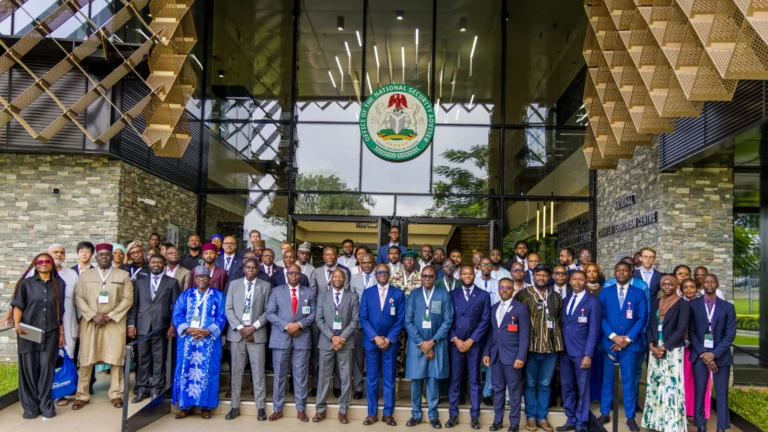
They made the call at the 3rd Africa High-Level Civil Society Anti-Money Laundering and Counter-Terrorist Financing (AML/CFT) Conference.
The conference was organised by Spaces for Change (S4C) West Africa and Civic Advisory Hub in collaboration with the Special Control Unit Against Money Laundering (SCUML) of the Economic and Financial Crimes Commission (EFCC).
The event is with theme:”Implementing FATF Recommendation 8 Correctly: Practices, Lessons Learned and Opportunities for Reform,” brought together government officials, regulators, financial institutions, civil society organisations and regional stakeholders among others.
The News Agency of Nigeria (NAN) reports that the conference is aimed at exchanging knowledge and identifying practical solutions to financial crimes.
It also provides a platform to exchange knowledge, share experiences and identify practical solutions for addressing financial crimes while supporting an enabling environment for civil society.
Speaking, the Board Chairman of Spaces for Change, Mr Samuel Diminas, said tackling illicit financial flows in Africa requires collective action by governments, regulators and civil society.
According to him, Africa loses more than 88 billion dollars annually to illicit financial flows, depriving the continent of resources needed for education, healthcare and development.
He said poorly designed and implemented AML/CFT regulations had also negatively affected legitimate non-governmental organisations through account freezes, financial exclusion and restricted access to banking services.
“Our task is to strengthen the integrity of our financial systems while safeguarding the civic space that holds those systems accountable.
“These goals are not in conflict; they reinforce each other. Compliance works best when it is collaborative and not adversarial,” he said.
Diminas urged participants to use the conference to build trust among regulators, financial institutions and civil society, while promoting African-led solutions that reflected the continent’s realities.
Also, the EFCC Chairman, Mr Olanipekun Olukoyede, said the implementation of the Financial Action Task Force (FATF) Recommendation VIII
should focus on organisations genuinely vulnerable to terrorist financing rather than imposing blanket restrictions on the entire non-profit sector.
Represented by the Director of SCUML, Mr Harry Erin, Olukoyede, said civil society organisations remained critical partners in humanitarian assistance, education, healthcare, peacebuilding and sustainable development.
He said Nigeria’s national terrorist financing risk assessment for the non-profit sector was conducted through broad consultations involving the EFCC, SCUML, the Nigerian Financial Intelligence Unit (NFIU), the Office of the National Security Adviser (ONSA), the Corporate Affairs Commission (CAC) and civil society organisations.
“The assessment has enabled Nigeria to move beyond broad assumptions towards a more targeted understanding of terrorist financing vulnerabilities.
“It has strengthened our ability to identify organisations genuinely at risk while ensuring that the overwhelming majority of legitimate non-profit organisations continue their work without unnecessary regulatory burdens,” he said.
The EFCC chairman said Nigeria’s experience demonstrated that effective implementation of FATF Recommendation 8 depended on trust, transparency, consultation and mutual respect among stakeholders.
He reaffirmed the EFCC’s commitment to strengthening Nigeria’s AML/CFT regime while supporting continental efforts to protect the integrity of financial systems and preserve the legitimate role of civil society.
Prof. Ben Saul, the United Nations Special Rapporteur on the promotion and protection of human rights while countering terrorism,said many governments had previously misinterpreted the recommendation by imposing unnecessary regulations on the entire non-profit sector.
He commended the 2023 revision of FATF Recommendation 8 for clarifying that it applied only to non-profit organisations considered vulnerable to terrorist financing risks.
He stressed that FATF required countries to adopt risk-based and proportionate measures rather than indiscriminate regulation.
According to him, excessive compliance requirements, poor risk assessments and overregulation had in many countries disrupted humanitarian activities, restricted civil society operations and contributed to financial exclusion through the closure of bank accounts and denial of banking services.
He also warned against the misuse of counter-terrorism measures to suppress civil society, saying such actions undermined freedom of association and humanitarian work.
Saul called for stronger engagement between governments and civil society in designing and implementing AML/CFT measures, noting that meaningful consultation would improve compliance while protecting human rights.
He said FATF’s recently introduced unintended consequences procedure would provide an additional mechanism for addressing cases where member countries misapplied FATF standards.
The conference continues with technical sessions on strengthening AML/CFT compliance, promoting financial inclusion and advancing reforms to ensure effective implementation of FATF Recommendation 8 across Africa. (NAN) (www.nannews.ng)
Edited by Sadiya Hamza
Comments