


By Justina Auta
The Federal Government has approved three national instruments to strengthen protection for women and children, as Nigeria grapples with only 52 sexual assault referral centres serving more than 200 million people.
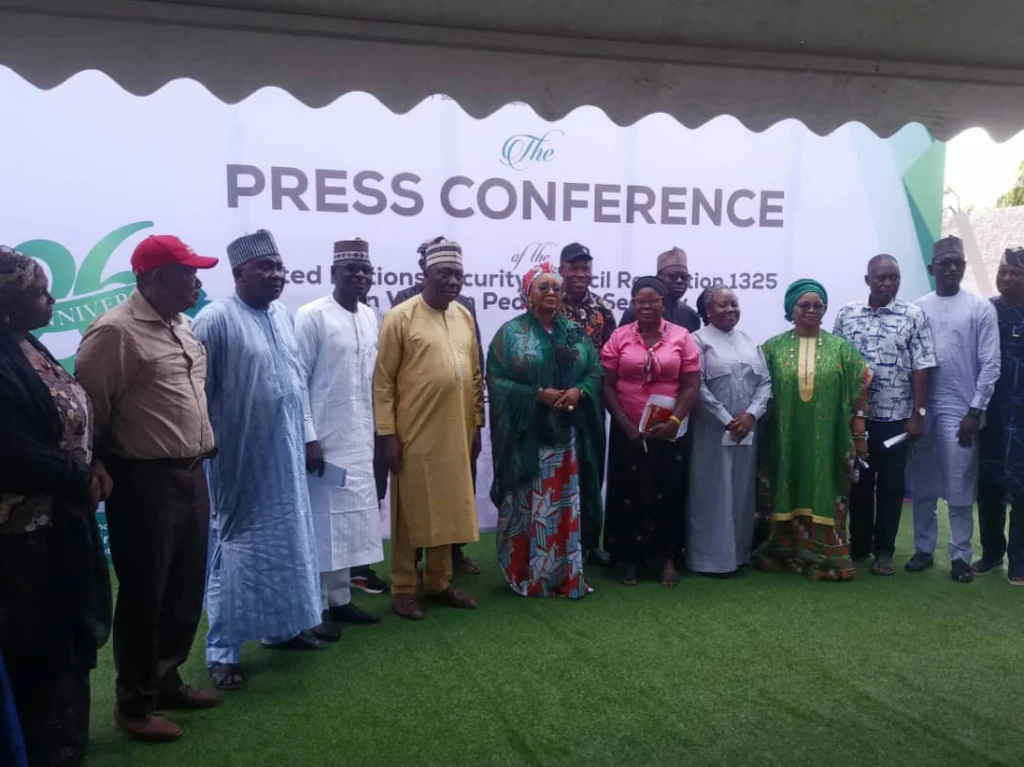
Hajiya Imaan Sulaiman-Ibrahim, Minister of Women Affairs and Social Development, said this on Thursday in Abuja during a news conference marking the 26th anniversary of United Nations Security Council Resolution 1325 on Women, Peace and Security.
The event was themed: “From Commitment to Impact: Advancing Women, Peace and Security through Inclusive Leadership, Local Action and National Accountability in Nigeria.”
Sulaiman-Ibrahim said the Federal Executive Council, presided over by President Bola Ahmed Tinubu, approved three national instruments presented by her ministry to strengthen protection, care and support for vulnerable groups.
She listed them as the National Action Plan on Ending Violence Against Children, National Policy on Menstrual Health and Hygiene Management, 2026–2030, and National Care Policy and Implementation Plan, 2026–2030.
“For a child, it means abuse is prevented before it happens and, where it does happen, that someone is there to act,” the minister said.
She added that the child protection plan would extend interventions to all 36 states and the Federal Capital Territory through a Pathfinder State Model.
On menstrual health, the minister said the policy would ensure girls were not forced to miss school because they could not afford sanitary products.
“For a girl, it means she should no longer have to stay home from school because she cannot afford a sanitary pad,” she said.
Sulaiman-Ibrahim said the policy would also support women-owned enterprises through local manufacturing of sanitary products and the establishment of Pad Banks in public spaces.
She said the National Care Policy would recognise unpaid care work and promote safe, regulated childcare and elderly care services to ease the burden on women.
“It means her work is finally recognised, and that safe, regulated childcare and elderly care will free her time to earn, learn and lead,” she said.
The minister explained that the approvals were connected to peace and security, noting that insecurity often began with social challenges within communities, including abuse and exclusion.
“Insecurity does not begin on the battlefield. It begins in the home where a child is abused, in the classroom a girl misses for want of a sanitary pad,” she said.
She, however, acknowledged gaps in addressing sexual and gender-based violence, noting that Nigeria currently had 52 sexual assault referral centres serving a population of more tha 200 million.
“Nigeria has 52 sexual assault referral centres serving over 200 million people. That is not enough, and we are working to add more,” she said.
The minister said the government was also strengthening the Child Rights Act and the Violence Against Persons (Prohibition) Act to address emerging threats.
She said that Nigeria’s Third National Action Plan on Women, Peace and Security, launched in December 2025, was built on five pillars.
The pillars include prevention, protection, participation, relief and recovery, and crisis response and emerging threats.
Sulaiman-Ibrahim said the government was committed to ensuring women moved beyond being victims of conflict to becoming active participants in peacebuilding and community development.
She said women were “not merely survivors, but peacemakers and pillars that hold every home and community together.”
Earlier, Ms Beatrice Eyong, UN Women Representative to Nigeria and ECOWAS, represented by Mr Peter Mancha, Programme Manager, said Nigeria had made progress in implementing UNSCR 1325.
Eyong, however, noted that the resolution was yet to be fully realised, as women continued to face barriers to participation and gender-based violence in different settings.
“This exclusion is not accidental: it reflects persistent institutional barriers, unequal power relations, and deeply entrenched gender norms,” she said.
She emphasised that women’s participation was more than symbolic representation, adding that their exclusion affected the issues addressed in peace agreements and conflict resolution processes.
“Peace is not sustainable without the full and meaningful participation of women as negotiators, mediators, signatories and witnesses,” Eyong said.(NAN)
Edited by Abiemwense Moru

Comments