







By Eniola Elewude
The Federal Government and the International Water Management Institute (IWMI) have mobilised stakeholders to advance policy, institutional and regulatory reforms to unlock Nigeria’s irrigation potential and boost food security.
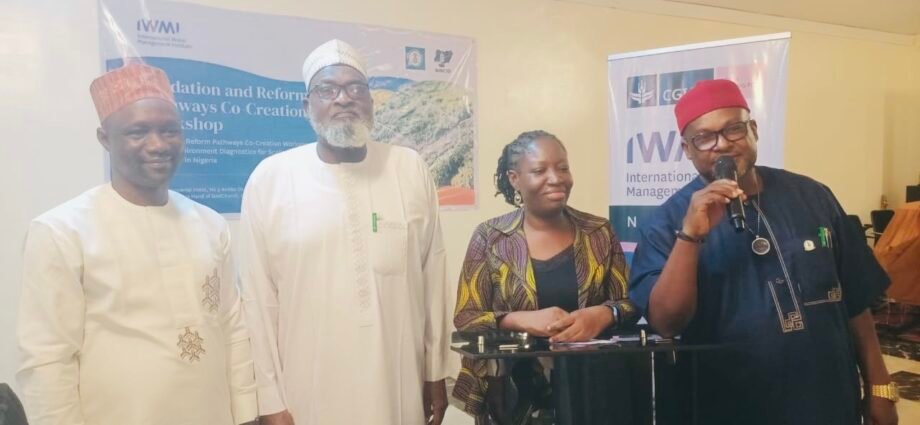
They made the call on Wednesday in Abuja at the Validation and Reform Pathways Co-Creation Workshop on Enabling Environment Diagnosis for Scaling Irrigation and Innovation in Nigeria, organised by IWMI.
The workshop brought together government officials, development partners, researchers, private sector actors and farmer organisations to identify challenges and develop pathways for scaling irrigation systems and innovations.
Senior Regional Researcher for Next Generation Irrigation Systems at IWMI, Mr Adebayo Oke, said Nigeria had over five million hectares of irrigable land, hundreds of irrigation schemes and numerous reservoirs and dams that remained largely underutilised.
He said this existed alongside food security challenges and low agricultural productivity, stressing the need to address policy, institutional and operational gaps affecting irrigation development.
Oke said IWMI had conducted assessments to identify challenges and policy gaps, adding that the findings would support recommendations for improving irrigation schemes and expanding farmer-led irrigation.
“Our ultimate goal is to contribute to policy review that will improve the performance of irrigation schemes and expand farmer-led irrigation in Nigeria,” he said.
 Representing the Minister of Water Resources and Sanitation, Prof. Joseph Utsev, the Director of Irrigation and Drainage in the ministry, Victor Ojiako, said irrigation was central to the government’s efforts to achieve food security, climate resilience and agricultural transformation.
He said climate change, water scarcity, population growth and rising food demand underscored the need to expand and modernise irrigation systems nationwide.
Ojiako said the ministry was committed to creating an enabling environment that promotes innovation, attracts investment, strengthens institutions and supports sustainable water resources management.
He urged stakeholders to develop practical solutions that would improve policy coordination, encourage private sector participation and promote gender and youth inclusion.
Also speaking, the Coordinator of the Sustainable Power and Irrigation for Nigeria (SPIN) Project, Mr Ipinlaye Olaiya, said assessments across six states revealed structural, regulatory and institutional gaps limiting irrigation expansion.
Olaiya, who represented by Deputy Director of Irrigation and Drainage, Ms. Anthea Udo, said the World Bank-supported SPIN project was designed to strengthen institutions, improve dam safety, modernise irrigation schemes and support sustainable agricultural productivity.
According to him, infrastructure investments alone would not deliver results without effective policies, functional Water Users Associations and inclusive frameworks for smallholder farmers.
He said the reform roadmap from the workshop would guide interventions and engagement with policymakers at federal and state levels.
The two-day workshop brought together stakeholders to validate diagnostic findings and co-create reforms for scaling irrigation innovation in Nigeria. (NAN)
Edited by Tosin Kolade