


By Funmilayo Adeyemi
The Federal Government says it will end the practice of tertiary institutions temporarily borrowing staff, equipment and facilities to meet accreditation requirements.
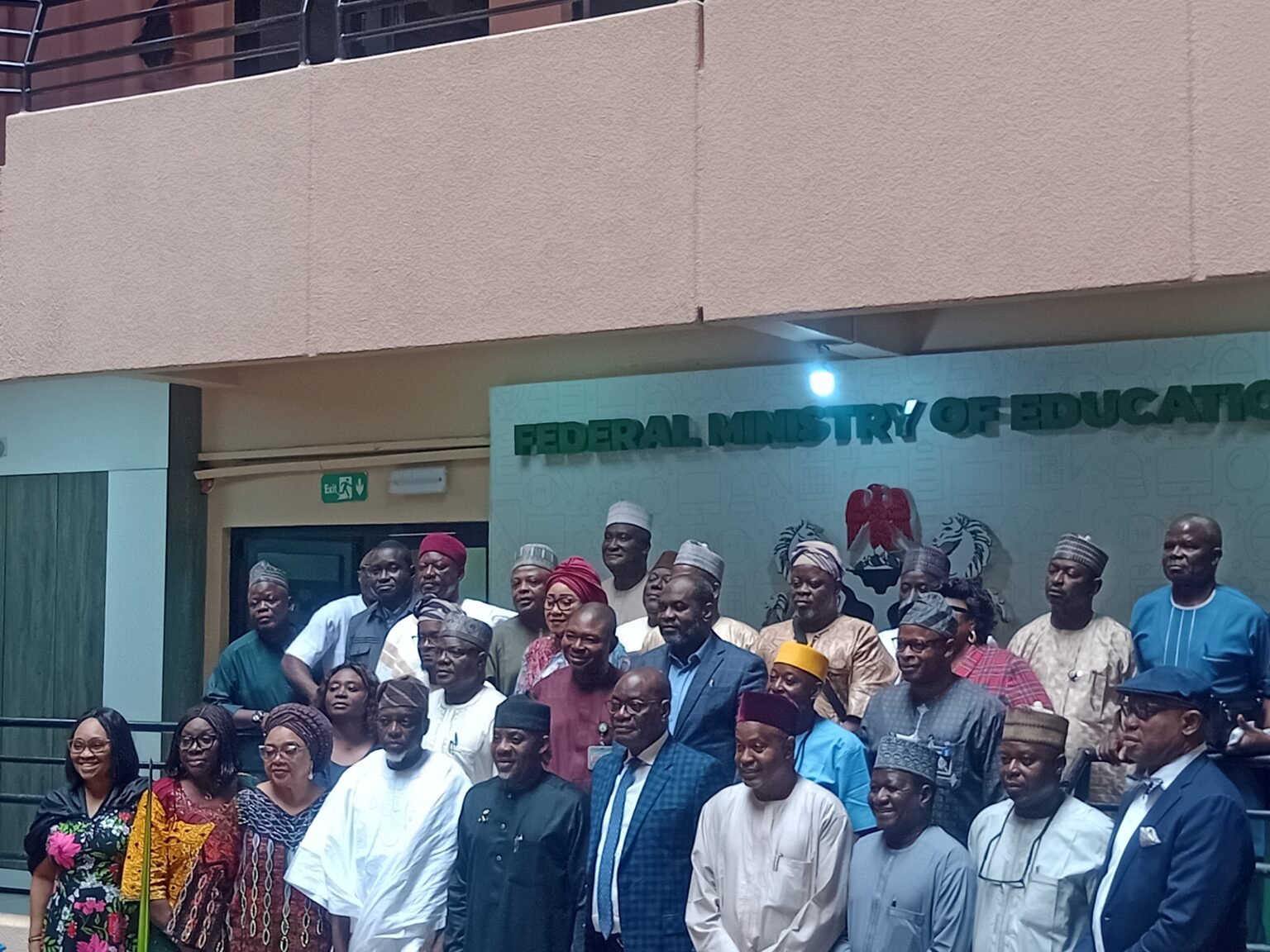
The Minister of Education, Dr Tunji Alausa, stated this on Wednesday in Abuja at the inauguration of the Ministerial Committee on Strengthening the Accreditation and Quality Assurance System for Tertiary Institutions.
The minister’s comments came against the backdrop of the controversy surrounding the accreditation of the Law programme of Atiba University, Oyo State.
Recall that in August, the Council of Legal Education (CLE) imposed a 10-year moratorium on the university’s Law programme, citing inadequate facilities and the institution’s admission and graduation of students without the requisite approval.
The development has affected students who had spent several years studying Law in the institution.
Parents have also appealed to the Federal Government and regulatory authorities to facilitate their transfer to accredited Law faculties to prevent their years of study and financial investments from going to waste.
Alausa, while inaugurating the committee, said accreditation should provide an accurate picture of an institution’s actual and sustainable capacity to deliver quality education, rather than a temporary representation prepared for an accreditation visit.
“An institution should not be able to prepare a temporary picture of itself simply for the purpose of an accreditation visit.
“Sadly, this is what persists in the majority of instances,” he said.
The minister said the government would address situations where academic and non-academic personnel were temporarily moved or presented for accreditation before returning to other institutions.
He said similar measures would be taken against the temporary movement, borrowing or presentation of equipment, laboratory facilities, workshop resources, library materials and other infrastructure solely for accreditation purposes.
According to him, what an accreditation team sees and verifies must represent the actual and sustainable capacity of the institution.
Alausa said the reform would strengthen the credibility, integrity, transparency, efficiency and sustainability of accreditation exercises across universities, polytechnics and colleges of education.
He said the National Universities Commission (NUC), National Board for Technical Education (NBTE) and National Commission for Colleges of Education (NCCE) had enormous responsibilities in safeguarding the quality of tertiary education.
“An institution should not meet prescribed standards only when the NUC, NBTE or NCCE accreditation team is expected to visit. Those standards should be met every day of the year.
“With a robust digital accreditation platform, much of the institutional information required for accreditation can be continuously maintained and periodically verified.
“Before an accreditation team arrives, the accrediting agency should already have reliable information on institutional staffing, facilities, laboratories, workshops and other equipment.
“The physical visit will remain important, but it should increasingly serve to validate verified data rather than begin the verification process from scratch,” he said.
The minister said the objective of the committee was not to weaken the existing accreditation system but to strengthen and modernise it through transparent, efficient, evidence-based and difficult-to-manipulate processes.
He directed the committee to develop mechanisms for verifying the authenticity and continuous availability of academic and non-academic staff presented for accreditation.
He also charged it to establish mechanisms for verifying the ownership, functionality, adequacy, accessibility and sustained availability of facilities and equipment presented by institutions.
Alausa said technology would be deployed to transform accreditation from a predominantly manual and episodic exercise to a digital, data-driven and continuously verifiable system.
He said geospatial mapping, geotagging and appropriate digital identification technologies should be deployed for physical infrastructure, laboratories, workshops and major equipment.
“Critical equipment presented for accreditation should be capable of being digitally identified and linked to a specific institution and physical location,” he said.
The minister also called for a comprehensive digital identity management and staff verification framework to establish the presence and institutional affiliation of personnel presented for accreditation.
He said the system should, subject to applicable laws and data protection requirements, leverage national identity infrastructure and interoperable government databases.
Alausa said collaboration with the National Identity Management Commission (NIMC) should be explored to use the National Identification Number (NIN), alongside appropriate use of the Bank Verification Number (BVN) infrastructure and other secure technologies.
He said such a system would help to establish the principle of “one individual, one verifiable identity and an accurately declared institutional affiliation”.
The minister said the system should also be capable of detecting situations where an individual was improperly presented as full-time personnel in multiple institutions.
Alausa expressed worry over the illegal students admitted in the tertiary institutions, noting that illegal admissions run into hundreds of thousands.
He attributed the failure to previous administrations allowing illegality in institution’s accreditation.
He, however, promised Nigerians that the present administration of President Bola Tinubu would henceforth not allow such in the tertiary institutions.
Responding, the Chairman of the Ministerial Committee, Prof. Is-haq Oloyede, former Registrar, Joint Admissions and Matriculation Board (JAMB), pledged the committee’s commitment to addressing abuses in the accreditation process.
Oloyede said accreditation should not be treated as an exercise for which institutions temporarily prepare, adding that constant monitoring was critical to ensuring that standards were maintained beyond accreditation visits.
He said the committee would also examine how regulatory and professional bodies could better integrate their accreditation processes and agree on relevant criteria, to prevent situations where students completed programmes but were unable to proceed to professional training or registration.
Earlier, the Director of Polytechnic Education in the ministry, Mrs Kalau Igwe, said the inauguration demonstrated the government’s commitment to ensuring a more robust, transparent and integrity-driven accreditation system.
Igwe said the practice of borrowing or temporarily moving resources, staff members and facilities for accreditation was not limited to universities but also occurred in other tertiary institutions.
She expressed optimism that the committee would help establish a more credible accreditation process that would improve the education sector and benefit Nigerian students.
The committee’s terms of reference include among others; reviewing existing accreditation policies, standards, guidelines, procedures and operational practices across the tertiary education regulatory framework.
It is also expected to identify loopholes and operational challenges that undermine accreditation; strengthen staff and resource verification; and improve the independence and accountability of accreditation panels. (NAN) www.nannews.ng
Edited by Tosin Kolade


Comments