


By Olasunkanmi Onifade
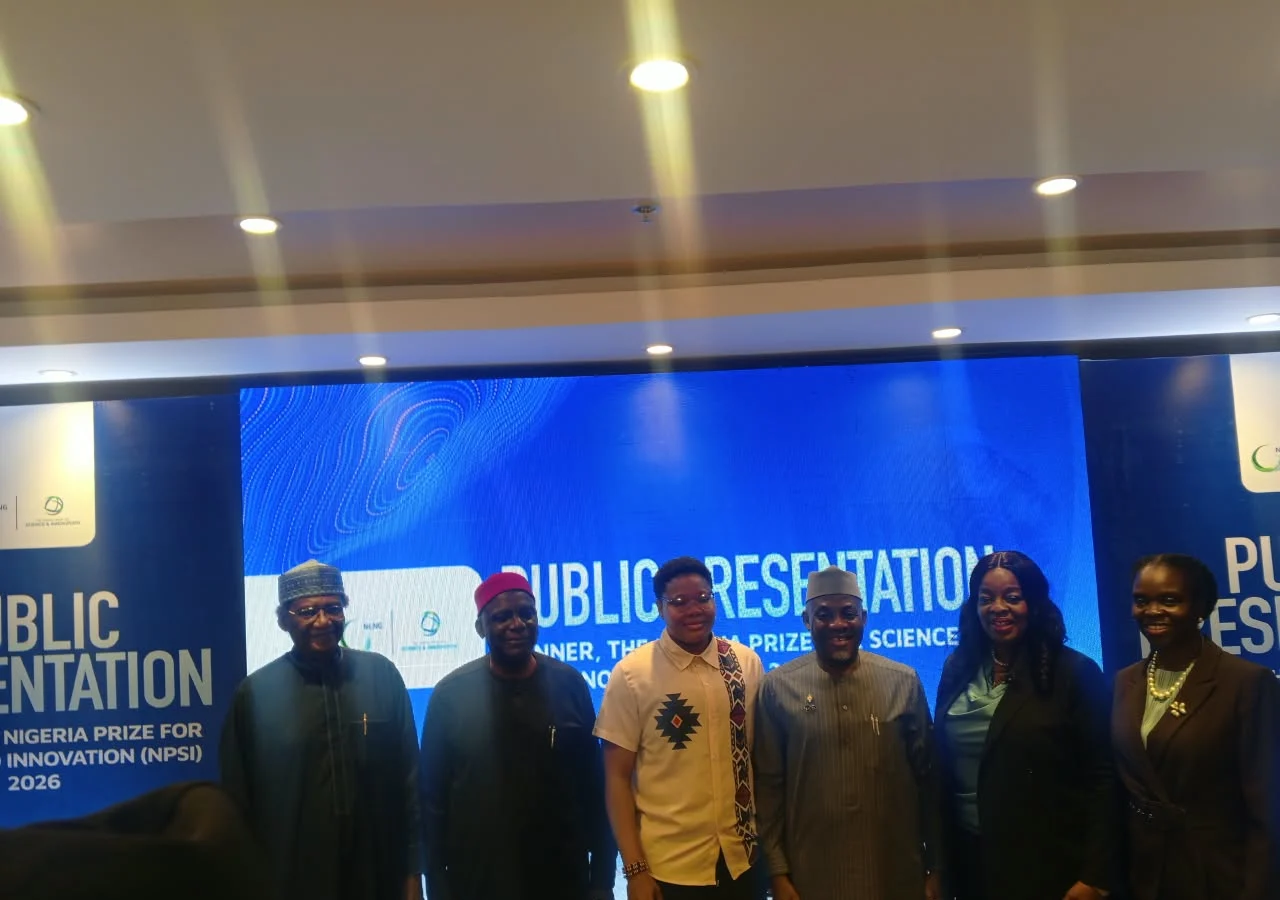
The Federal Government has pledged support for Ms Mary-Brenda Akoda, winner of the 2026 Nigeria Prize for Science.
The Minister of Education, Dr Tunji Alausa, made the pledge on Monday in Abuja at the public presentation of the prize organised by Nigeria LNG Limited (NLNG) in Abuja.
Akoda’s invention, GenScan AI, reduces Magnetic Resonance Imaging (MRI) scan time by up to 90 per cent without requiring new hardware.
He described the innovation as a phenomenal breakthrough capable of transforming diagnostic imaging and saving lives.
“You have reduced a 60-minute MRI scan to six minutes.
“This will save lives and make you a billionaire in dollars. You need to copyright and trademark this immediately,” he said.
He said the same technology could be extended beyond MRI to CT scan, X-ray and angiography, adding that Akoda’s feat demonstrated that Nigeria’s education system was capable of producing global talents.
Alausa pledged to facilitate linkage between the innovator and the Committee of Chief Medical Directors of federal teaching hospitals for national pilots.
He said the innovation aligned with President Bola Tinubu’s Renewed Hope Agenda.
The Minister of Innovation, Science and Technology, Dr Kingsley Udeh, said the ministry was in charge of innovation and commercialisation of research outcomes.
He was represented at the event by the Director-General of the National Board for Technology Incubation (NBTI), Kolawole Raji.
He said NBTI, established in 1993 with mandate to commercialise research, had received more than 5,000 entries so far in 2026 under its NextGen Innovation Challenge.
He said it had shortlisted 290 innovators using NASA Technology Readiness Assessment framework to ensure transparency.
Udeh said 105 innovators taken to London in 2026 did not abscond with one of them securing 1.5 million pounds investment for solar financing.
He said another one who developed a solution for breast cancer detection secured investor interest in Estonia.
He said that 298 innovators would be taken to London for an international showcase at the ExCeL Centre where investors from commonwealth nations, Europe, America, Canada and Middle East would engage them.
Dr Sophia Horsfall, General Manager, External Relations and Sustainable Development, NLNG, said the prize was established not only to recognise scientific achievement but to encourage researches that address Nigeria’s challenges.
She said that scan quality was often affected by acquisition time and patients’ inability to remain still.
She said GenScan AI emerged winner from 237 entries after rigorous adjudication, with judges noting its ability to reduce acquisition time, enhance image quality and accommodate patient motion.
In her presentation, Akoda, said the innovation was inspired by personal experience of delayed diagnosis
She is an AI Research Scientist and Google DeepMind Scholar with a Master of Research in AI and Machine Learning from Imperial College London.
Akoda said the innovation was inspired by personal experience of delayed diagnosis.
Akoda explained that GenScan AI works like completing a puzzle with fewer pieces, using AI to reconstruct full diagnostic quality images from just a fraction of data, enabling a 20-minute scan to be done in two minutes.
She said a blinded radiologist assessment at Buckinghamshire NHS Hospital in the UK scored GenScan AI images as diagnostically equivalent to conventional scans with up to 99.7 per cent similarity.
According to her, a health economics study shows that even at four times speed up, the technology could enable over 40,000 additional patients to be scanned per week.
She said the research originated from Imperial College London and had received backing from Innovate UK.
She said supported by UK Research and Innovation and the NHS Clinical Entrepreneur Programme, with clinical partners in the UK, U.S., Korea and Nigeria.
The chairman of the advisory board committee, Prof. Barth Nnaji, said there was no winner in 2025 because no entry met required benchmarks.
The Nigeria Prize for Science and Innovation carries a $100,000 reward and recognises research with practical benefits to society.(NAN)
Edited by Uche Anunne

Comments