


By Naomi Sharang
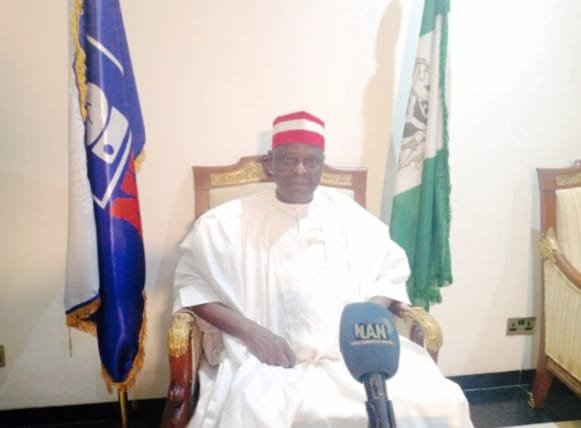
The Vice-Presidential Candidate of Nigeria Democratic Congress (NDC), Sen. Rabiu Kwankwaso, has called on the Federal Government to call an Islamic cleric, Sheikh Sani Yahaya-Jingir, to order over his recent anti-Christian statement.
Kwankwaso made the call in an interview with the News Agency of Nigeria (NAN) on Wednesday in Abuja.
NAN reports that Yahaya-Jingir had, at an event in Kano State while canvassing support for a Muslim-Muslim presidential ticket ahead of the 2027 elections, described Christians as “infidels”.
Kwankwaso, a former Kano State governor, however, said such views do not represent the position of the majority of northern Muslims.
He described Yahaya-Jingir’s comments as inappropriate and capable of deepening religious and political divisions in the country.
He appealed to the federal government as well as the Wife of the President, Oluremi Tinubu who, he said, is only a Christian but a pastor, to intervene and caution the Islamic cleric.
According to him, the continued propagation of such views is not in the interest of national unity.
“I believe it is not correct. What Malam Yahaya-Jingir is saying is not correct, and it will only succeed in further dividing the country,” Kwankwaso said.
He urged the Islamic cleric to reconsider his position, stressing that Christians and other non-Muslims are Nigerians with equal rights, including the right to vote and participate in the country’s political process.
The vice-presidential candidate described the religious rhetoric targetted at non-Muslims as also a poor political strategy, as the electorate comprise Muslims, Christians and adherents of other faiths.
Kwankwaso said that the comments were particularly concerning because Yahaya-Jingir is a respected religious figure whose pronouncements could influence public opinions.
He noted that he had personally enjoyed a cordial relationship with the Islamic cleric in the past and had respected him for many years.
“I have a lot of respect for him but I do not know what happened, especially from 2023 to this period, for a leader at that level to come out and make such statements,” he said.
The former governor also commended Christian leaders who recently engaged President Bola Tinubu on issues affecting Nigerians, including hunger, insecurity, poverty and unemployment.
He said that religious leaders should speak truth to power irrespective of their political affiliations or personal preferences, adding that their intervention could help the government in addressing pressing challenges.
Kwankwaso urged Muslim leaders to similarly engage the president constructively and draw his attention to the difficulties confronting Nigerians.
The former, who described himself as a moderate Muslim, stressed the importance of religious tolerance, peaceful coexistence and responsible leadership.
Reflecting on Kano’s political history, he recalled how the 2003 election campaign was dominated by debates around the implementation of Sharia which, he said, created significant religious tension.
He said that some politicians at the time promised that the implementation of Sharia would automatically address social and economic challenges, including unemployment, education and access to marriage.
He said that the experience later demonstrated that political rhetoric centred on religious identity could not substitute for effective governance.
Kwankwaso said that the people of Kano had since become more focused on practical issues, including education, security, employment and improved living conditions.
He cited that the 2023 Kano election as evidence that voters were increasingly concerned about governance rather than religious slogans.
The former governor listed the major concerns of northern communities today to include insecurity, banditry, kidnapping, poverty and the education of young people.
“Kano is a wrong place for such a campaign. The people of Kano are very clear. What they want is how to send their children to school and get a good life,” he said.
Kwankwaso appealed to Christian leaders not to be overly worried by Yahaya-Jingir’s comments, assuring them that the views did not reflect those of the majority of northern Muslims.
“I want to appeal to the Christian leaders that that opinion is not the opinion of the majority of northern Muslims. I don’t think they should worry about themselves. We are in a position to handle the situation,” he said.
He urged political and religious leaders to avoid statements capable of inflaming religious sentiments, saying that Nigeria needed unity and responsible leadership to overcome its current challenges.
Kwankwaso said that the country had moved beyond the period when religious slogans could easily mobilise large sections of the electorate, adding that Nigerians were increasingly demanding tangible improvements in their lives.
He called on Yahaya-Jingir to reconsider his position and work toward messages capable of promoting peaceful coexistence rather than division.
The NDC vice-presidential candidate said Nigeria’s political leaders must recognise that the country belonged equally to Muslims, Christians and other religious groups, adding that no section should be made to feel excluded.
He stressed that the overriding responsibility of political and religious leaders should be to protect national unity and promote the welfare of all Nigerians.
Kwankwaso said responsible leadership required listening to people at all levels and responding to concerns about hardship, insecurity, unemployment and poverty.
He urged Nigerians to reject any attempt to exploit religious differences for political advantage, saying that the country could only achieve meaningful development through unity and cooperation.
The former governor added that northern Muslims should not be collectively associated with statements that could undermine peaceful relations between communities and faiths.(NAN)(www.nannews.ng)
NNL/FEO/WAS
Edited by Francis Onyeukwu/’Wale Sadeeq
Comments