


By Mercy Sawok
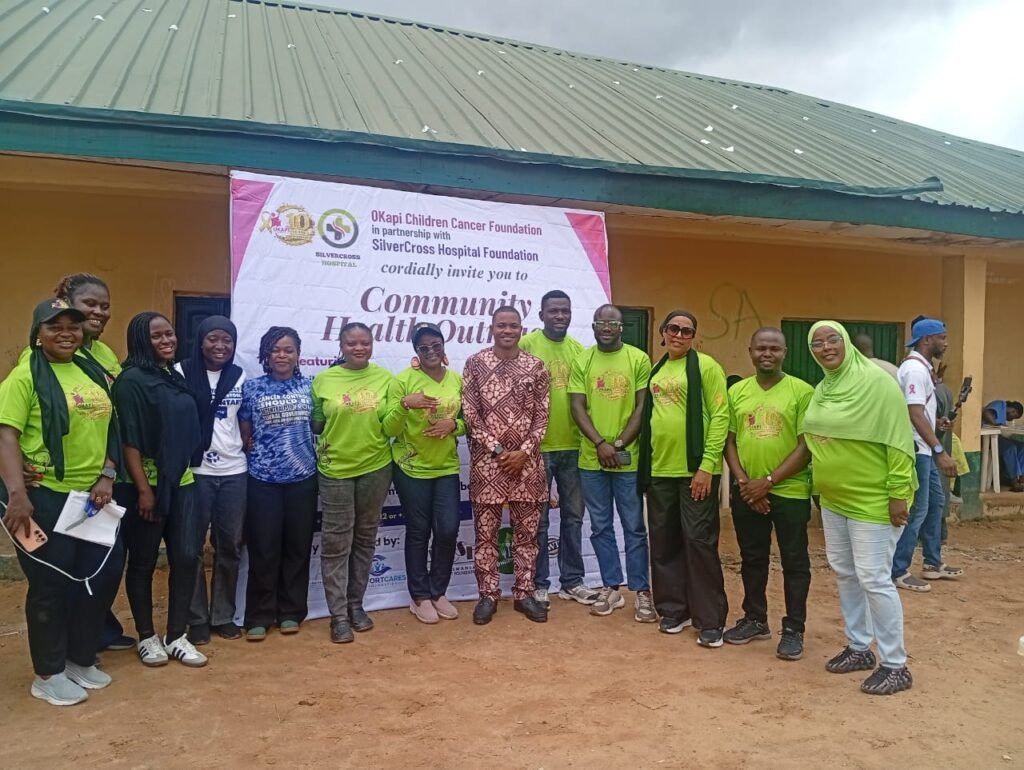
The Okapi Children Cancer Foundation, in partnership with Silver Cross Hospital Foundation, has taken childhood cancer awareness, free medical screening and skills acquisition to residents of Karu-Biyi, Karumajigi community, Abuja, on Saturday.
The outreach aimed to sensitise residents to childhood cancer, promote early detection and treatment, provide basic healthcare services, and create economic empowerment opportunities for women in the community and vulnerable households.
Speaking during the programme, founder of the Okapi Children Cancer Foundation, Dr Kemi Adekanye, said the initiative was designed to address low awareness about childhood cancer across many communities nationwide.
Adekanye said many people associated cancer mainly with adults, noting that children also battled the disease and required early diagnosis and appropriate treatment to improve survival and recovery outcomes significantly.
She said the foundation had been taking awareness campaigns to communities, alongside free health outreaches and, more recently, skills acquisition programmes designed to provide broader support for families and caregivers alike.
She said the programme focused on three interventions for community residents:
“Today, we are doing awareness on childhood cancer, health outreach and skills acquisition for members of Karumajigi community.
“The foundation hopes to increase awareness so parents and caregivers recognise unusual symptoms in children and seek medical attention promptly before conditions become difficult to treat or manage effectively.”
She recalled that during a previous community outreach, two children were identified with cancer after their parents had initially been unaware of their condition and had not sought specialist medical assessment.
Adekanye urged parents to speak up and seek medical help whenever they noticed anything unusual about their children, emphasising that prompt action could save lives and improve treatment outcomes significantly.
She, however, called for greater government intervention in cancer care, particularly through subsidising treatment costs and expanding health insurance coverage for children with cancer across Nigeria to reduce the burden.
“Cancer treatment is very expensive. Even an average middle-class person who has cancer will probably go bankrupt,” she said, describing the financial burden facing ordinary families seeking treatment in Nigeria.
“If government can intervene in subsidising the cost and include children in health insurance schemes, it would really go a long way in supporting families who have children with cancer,” Adekanye said.
Also speaking, Dr John Balogun, a paediatric oncologist at the University of Abuja Teaching Hospital, said early recognition of childhood cancer symptoms was critical to improving treatment outcomes for children and families.
Balogun said some symptoms of childhood cancer could resemble common illnesses such as malaria and typhoid, making it important for parents to seek medical attention when symptoms persisted or worsened noticeably.
He identified warning signs including persistent fever, unusual paleness, whitish coloration in the centre of the eye, bulging eyes, persistent bone pains, weakness, swelling and prolonged headaches among affected children nationwide.
The paediatric oncologist also dispelled beliefs that childhood cancer was a death sentence or caused by witchcraft, explaining that cancer resulted from abnormal cell division within affected body tissues of children.
He said many childhood cancers could be cured when detected and treated early, noting that developed countries recorded cure rates exceeding 80 per cent, while Nigeria faced late presentation challenges persistently.
Balogun said another major challenge confronting families was the financial burden of cancer treatment, describing it as “financial toxicity”.
According to him, that often forces families to interrupt care or delay treatment altogether unnecessarily.
He appealed to government to ensure cancer medicines were adequately covered by health insurance programmes, enabling children to access treatment, and called for stronger awareness campaigns nationwide and better referrals.
He suggested incorporating childhood cancer awareness into school curricula, arguing that early education could help children, parents and teachers recognise warning signs and encourage prompt referrals for care when necessary.
The Village Head of Karu-Biyi in Karumajigi community, Chief Dauda Dogo, expressed appreciation to organisers for bringing the programme to the community and providing valuable health information and services.
Dogo said the awareness had equipped community members with knowledge about cancer signs and encouraged residents to share the information with others while lauding the free medical screening and medication provided.
The traditional leader pledged that community leaders would continue sensitising residents and engage ethnic and faith leaders to ways of supporting vulnerable members of community and urged government support for healthcare.
A cancer survivor and advocate, Mrs Mariam Atswandeh, said her experience with breast cancer had taught her the importance of paying attention to changes in the body and seeking medical advice.
Atswandeh, who said she was in her fourth year as a survivor, recalled significant weight loss and severe back pain for several months before her diagnosis was eventually confirmed by doctors.
She said financial constraints remained among the major challenges facing cancer patients, alongside inadequate access to care and information, with many struggling to sustain treatment because drugs remained expensive.
She appealed to government, philanthropists and other stakeholders to provide greater support for cancer patients and advocacy organisations, particularly those helping vulnerable families navigate treatment and survivorship challenges across the country.
Meanwhile, founder of Fill and Feed a Soul International Outreach, Augusta Orji, said her organisation supported the programme by providing free HIV screening as part of the medical outreach.
Orji said the organisation also provided food, medical and educational support to vulnerable community members, adding that those who tested positive for HIV would receive counselling and appropriate referrals for care.
The programme also featured skills acquisition and empowerment for women, with beneficiaries receiving training and starter packs designed to help them establish small businesses and generate income locally.
One beneficiary, Nafisat Ibrahim, thanked organisers, saying she received a popcorn-making starter pack after completing training, and noted that the skill required relatively little capital to start a business successfully herself.
Ibrahim said she intended to use the starter pack to generate income and teach other women the skill, describing the empowerment as an opportunity to become economically independent and support others.
Another beneficiary, Abida Abdullahi, a housewife, said she was happy with the empowerment programme and pledged to share the knowledge acquired with other women so they could also benefit from it.(NAN)(www.nannews.ng)
Edited by Abiemwense Moru
Comments