

















Nigeria’s uneven journey to digital health: The winning model
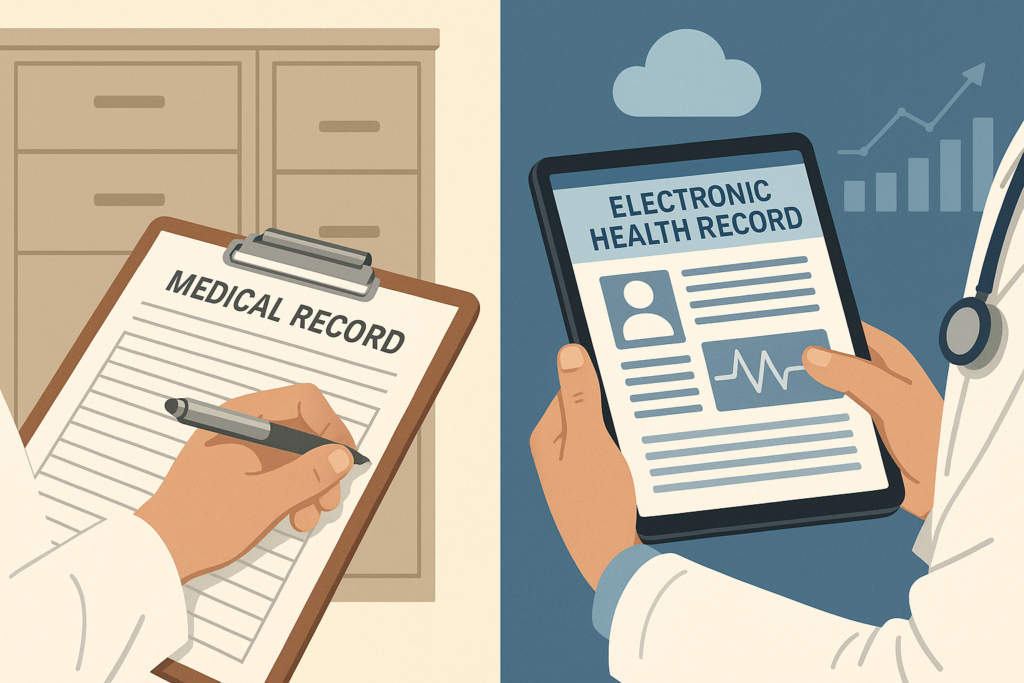
By Usman Aliyu & Ibukun Emiola, News Agency of Nigeria (NAN)
At the outpatient wing of the University College Hospital (UCH), Ibadan, Oyo State, South-West Nigeria, Mrs Bose Ayinde waited as hospital staff moved her patient’s file from one unit to another.
As a caregiver, she followed the process – payments in one section, tests in another, and repeated trips across departments to track results and next steps.
Hours into a surgical procedure for her relative, she was told a test would have to be repeated; so the process of drawing blood sample from the patient and submitting it at the lab was done all over. One of the earlier results had been misplaced.
“If it was digitised, we wouldn’t go back and forth. It would be faster,” she says, her voice edged with fatigue.
Her experience reflects a routine familiar to many at UCH, one of Nigeria’s oldest tertiary health institutions, established in 1957.

In spite of its status, much of its records management still relies on paper.
From registration to diagnosis, patients and their caregivers navigate a system where information moves physically rather than electronically.
Files are transferred between units, payments processed at separate points, and results retrieved manually – sometimes after long delays, and occasionally not found at all.
A diagnostic staff member, Mr Ridwan Abegunde (not his real name), describes the process as fragile.
“Patients go from one unit to another with paper results. Sometimes results get missing. There is no electronic transmission,” he says.
A widespread national challenge
Nigeria’s situation reflects a broader pattern across many low- and middle-income countries, where digital health systems are still evolving.
According to the World Health Organisation (WHO), a significant number of health facilities in sub-Saharan Africa continue to rely on paper-based records, limiting efficiency, data sharing and continuity of care.
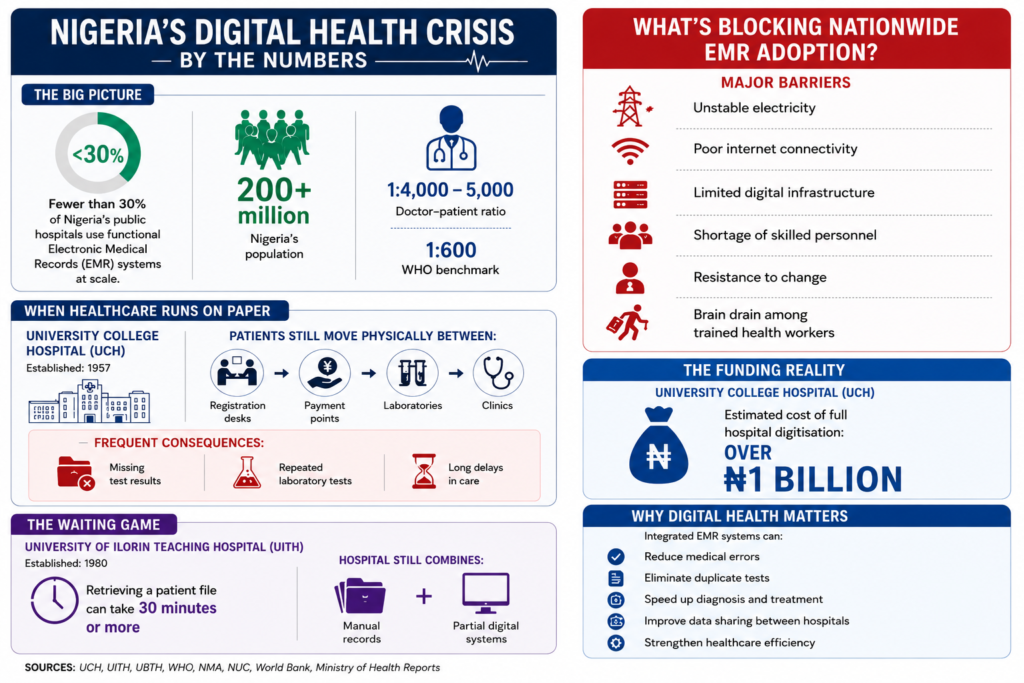
In Nigeria, experts estimate that less than 30 per cent of public health facilities operate functional electronic medical record systems at scale, with most institutions adopting partial or pilot digital solutions.
The implications are far-reaching in a country with a population of over 200 million people and a strained healthcare system.
Nigeria, according to the Nigerian Medical Association (MMA), currently has about one doctor to between 4,000 and 5,000 patients, far below the WHO recommended ratio of 1:600, increasing pressure on already overstretched facilities.
Nearly 300 kilometres away at the University of Ilorin Teaching Hospital (UITH), North-Central Nigeria, the experience is similar, but evolving.
On average, retrieving a patient’s file can take about 30 minutes, if the case note has not been misplaced.

For Hajia Dije Sanni, an outpatient at the hospital, the process has been both repetitive and frustrating.
“The last time I visited the hospital was quite disheartening. I had to buy a new exercise book, re-register, and pay for consultation all over again.
“When patients are repeatedly asked to open a file, the process is bound to be duplicated unnecessarily. This should not be the case,” she says.
Established on May 2, 1980, as part of Nigeria’s second generation of teaching hospitals, UITH was designed to deliver specialised healthcare and clinical training.
Yet, like many public facilities, it is still navigating a gradual transition, operating a mix of manual and digital systems.
Dr Taiwo Oyeleke, Head of Records, confirms this hybrid reality.
“We have passed the pilot stage in some areas, but in others we combine both manual and digital systems for now,” he says, noting that infrastructure gaps and limited connectivity still constrain full rollout.
A model emerging in Benin
In Benin City, however, a different reality is unfolding at the University of Benin Teaching Hospital (UBTH), established in 1973.
Here, the transition to an Electronic Medical Records (EMR) system is reshaping how care is delivered, offering a practical example of what Nigeria’s digital health ambitions could look like when implemented at scale.
At the hospital, the patient journey has been redesigned around digital flow rather than physical movement of files.
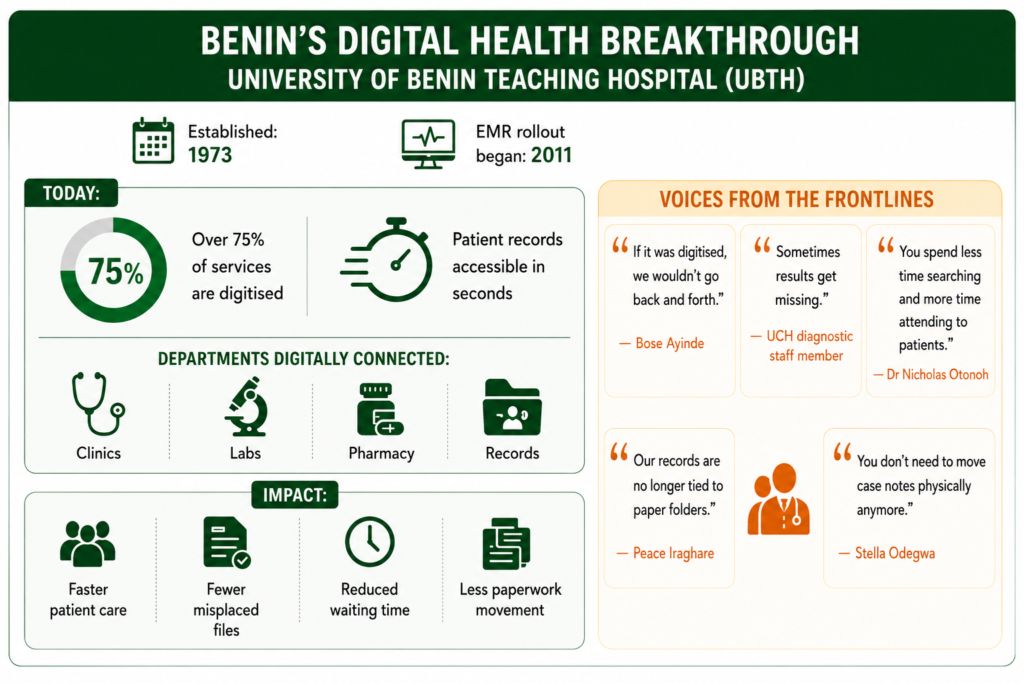
This electronic system began in 2011, according to Mr Faith Ewere, its Head of Information and Communication Technology (ICT).

Patients say the impact of the electronic system is most visible in how care is accessed and how time is spent.
For Peace Iraghare, who has used the hospital for decades, the difference is clear.
“Those days, sometimes when we came back, we might not see our tests. They would have been lost or misfiled.
“But today, our records are no longer tied to a paper folder. They exist in a digital system that doctors can access within seconds,” she said.
Mrs Stella Odegwa, Head of Health Information Management, says once a patient registers and makes payment, their details are entered into the system and become instantly accessible across relevant units.
“Once they come with proof of payment, we post their details. The nurse takes vital signs and enters them into the system. From there, the patient proceeds to the doctor,” she explains.

At the consultation point, clinicians simply input the patient’s details to retrieve full medical history in seconds. Prescriptions, laboratory requests, and referrals are initiated electronically within the system.
“If a patient is sent to the lab or pharmacy, the information is already there. There is no need to carry paper from one place to another,” she said.
This internal interoperability – linking departments such as records, clinics, laboratories, and pharmacies – has reduced reliance on manual transfers and minimised the risk of lost files.
“It has reduced waiting time and misfiling. You don’t need to move case notes physically anymore,” Odegwa adds.
Benefits and limitations
For clinicians, the EMR system has streamlined workflow and improved decision-making.
Dr Nicholas Otonoh of the General Practice Clinic says patient data is now instantly accessible, reducing delays associated with file retrieval.
“You spend less time searching and more time attending to the patient,” he says.
However, the system is not without challenges.
Network reliability remains a critical concern, while power supply constraints require investment in backup systems such as inverters and solar power.
Ewere notes that while the hospital has deployed EMR across more than 75 per cent of its services, the system is still evolving.
“The previous system is a legacy system. It cannot meet current demands, especially for web-based access,” he says.
Policy ambition vs reality
Nigeria’s push for electronic medical records is part of a broader effort to build Digital Public Infrastructure (DPI)—systems designed to enable efficient, data-driven public services.
Within healthcare, interoperability is central to that vision.
However, experts say the country’s health data systems remain fragmented, with most hospitals operating in silos and unable to share patient information seamlessly.
Dr Emeka Chukwu, a digital health expert, says the benefits of integration are significant.
“It enhances patient care through information sharing across institutions, reduces duplication, and improves safety by minimising errors,” he said.
But achieving this requires more than technology.
“You need reliable electricity, strong internet, adequate hardware, skilled personnel, and clear standards,” he adds.
Cost, capacity and the road ahead
At UCH, Chief Medical Director Prof. Abiodun Otegbayo, estimates that full digitisation would require over N1 billion.
“That kind of funding is not readily available,” he says.
Nigeria’s public health spending remains below the Abuja Declaration target of 15 per cent of national budget, limiting large-scale investments in infrastructure such as digital health systems.
Beyond funding, human factors also play a role.
Resistance to change, coupled with the migration of skilled health workers, continues to slow adoption.
“If you train people and they leave, you have to start again,” Otegbayo said.
A system at a crossroads
Back in Ibadan, as patients continue to navigate hospital corridors with paper files in hand, the contrast with Benin City underscores what is at stake.
UBTH’s experience shows that digital transformation is possible even within Nigeria’s constraints—when there is sustained investment, institutional commitment and phased implementation.
Nonetheless, experts caution that digitalisation alone is not enough. Systems must be reliable, integrated and scalable to deliver real impact.
For patients like Mrs Ayinde, the consequences are immediate.
Her experience, repeating tests due to missing records, is not just an inconvenience, but a reflection of a system still struggling to connect care.
Until Nigeria fully integrates its digital health systems, healthcare delivery will remain fractured.
Experts say that these administrative bottlenecks, caught between outdated paper records and modern progress, can unfortunately mean the difference between life and death.(NANFeatures)
Edited by Chijioke Okoronkwo
***If used, please credit the writer and the News Agency of Nigeria.
This report is produced under the DPI Africa Journalism Fellowship Programme of the Media Foundation for West Africa and Co-Develop.