


Northern women battle backlash for speaking against norms on social media
By Aisha Gambo
Few minutes after Lubna Saleh posted a video on her Facebook page in November 2025, vile comments followed from many of her followers. Her post centred on the need for parents and single ladies to investigate a man’s character before accepting a marriage proposal.
“Shegiya tsinanniya, Karuwa”,one of the commenters wrote. This translates to accursed bastard and a prostitute in Hausa, a language spoken by majority in Northern Nigeria.
In a different post, where she advised women not to put up with irresponsible behaviour from men on TikTok, another follower called her a disgrace to northern women and a western puppet who was on contract to deceive women to abandon their marriages.
By midnight, hundreds of comments had flooded her page. Some mocking her appearance, others accusing her of deviating from religion and culture as well as labeling her as an infidel.
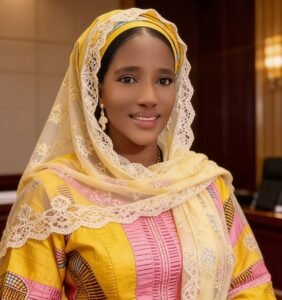
Lubna Saleh
Then came the threats, a TikTok user, Zero5, threatened to deal with her whenever he meets her. Another user, Anti_ Feminist, placed a N50,000 reward to anyone who can provide him with her number or house address. All comments were written in Hausa language.
“Friends and family members were often worried about my safety and my mental health, but I was not shaken by the harsh words. I understood exactly what was happening and why.
“I do think about the possibility of being attacked sometimes, especially considering the kinds of threats that can come with speaking openly about difficult issues. However, I have never truly felt unsafe,” says Saleh, a women’s rights advocate from Adamawa state.
Her offence was speaking about the realities many women were silently facing within marriages in Northern Nigeria and the need for their liberation from harmful practices and injustice.
Saleh had introduced the “Mun Bokare” slogan , a bold and aggressive way of saying “we refuse” which she says represents a refusal to continue accepting brutality, Injustice and silence.

Zainab Bello (Risewithxeeyyrious)
Saleh’s experience was not an isolation. A female content creator from Bauchi state who is now based in Abuja, Zainab Bello, known as Risewithxeeyyrious on TikTok, was called “Jaka” which literally means a donkey but can also be referred to as dumb. This was because she encouraged women to believe in themselves, pursue opportunities, and contribute positively to society.
Rasheeda Noro, the founder ROtv24, who uses Facebook platform to enlighten women on financial freedom and life after divorce, faced similar attacks. The reaction she got for calling out those who wrote bad comments about her post was not what she expected.
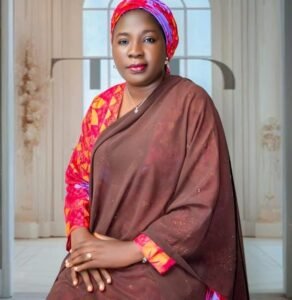
Rasheeda Noro, founder ROtv24
A dangerous trend
The experiences of these Northern women advocates reflect a wider global pattern. According to data from UN Women between 16 and 58 per cent of women and girls globally report experiencing some form of online violence or harassment, including cyberbullying, trolling, hate speech, doxing, sexual harassment and threats
Younger women are particularly vulnerable, with about 38 per cent of women globally reporting direct experiences of online abuse. Studies also show that women in public-facing roles face disproportionate attacks, with more than two-thirds of women journalists, activists and human-rights defenders across 119 countries reporting online abuse.
For the women interviewed in this report, the attacks often intensified when they discussed issues such as women’s rights, gender expectations and social change.
Their experiences suggest that online harassment may not only be random abuse, but can also function as a mechanism to silence or discourage women’s participation in public conversations.
A pattern of abuse and gendered insults
Some of the comments reviewed by this reporter show a pattern of abusive and gendered insults directed at these women following their online posts.
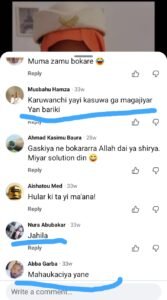
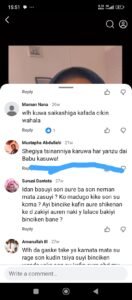

Screenshots of abusive comments under Saleh’s Facebook and TikTok post
Saleh, a 42 -year-old Journalist and educator who grew up in Adamawa state, Northeast , Nigeria, was repeatedly described in Hausa as “mad,” “ignorant” and “a prostitute,” mostly by different male facebook users while other comments included hate-filled statements and sexually suggestive insults aimed at humiliating her.
This is against Meta’s Community Standards which states that users who engage in bullying, harassment, hate speech, or other abusive behaviour may face enforcement actions such as content removal, account restrictions, suspension, or permanent disablement of accounts for repeated or severe violations.
On TikTok, the negative and abusive comments continued, a user, identified as Bash called her a refugee saying “Ki dawo Kasar ki mana kiyi magana ki gani, banza Kazama” in Hausa which means “come back to your country and talk and see what will happen, nonsense, dirty”.
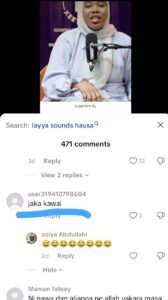
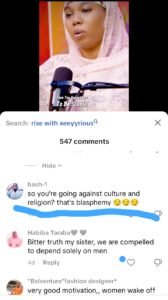
Screenshots of abusive comments on Bello’s TikTok post
For Bello, a 30 year-old married woman passionate about women empowerment, the comments were more of criticism framed in moral and religious language.
One TikTok user described her call for women to be financially independent as feminism which he called “sin promotion,” linking it to religious concepts of wrongdoing and spiritual destruction.
Another user dismissed her arguments by framing them as a violation of culture and religion, with one comment describing her position as “blasphemy”.
This goes against TikTok’s published guideline which prohibits harassment, degrading behavior, threats and coordinated abuse.
Noro had her fair share of abuse where one Facebook user called her a prostitute in Hausa and she responded with “an animal in human form” in English. Her reaction led to her account being banned for a week by Facebook for violating platform policies.
This shows the human oversight in Meta’s moderation process which flagged Noro’s reply as a violation because it recognised English immediately while leaving the abusive comment in Hausa.
Platforms moderation in local languages
When contacted by this reporter on how Meta moderate content in Hausa language, the communication team says there were AI systems that support languages spoken by 98 per cent of internet users, including major Nigerian languages such as Hausa, Yoruba, and Igbo, an expansion from its previous coverage of about 80 languages.
The company, which owns Facebook, added that the systems were designed to understand cultural nuances, region-specific slang, coded language, and changing online trends.
Meta, however, noted that human oversight remains central to its moderation process, stating that experts still review content, update policies, train and assess AI models, and make complex decisions on high-impact cases.
TikTok said it moderates content in more than 70 languages and uses specialised guidance and keywords covering several local languages, including Hausa, to identify and remove harmful content such as misinformation, hate speech, harassment, and bullying.
The platform said most violative content is removed proactively before it is reported, but encouraged users to help keep the platform safe by reporting content that breaches its Community Guidelines.
According to TikTok’s Community Guidelines Enforcement Report for the fourth quarter of 2025, more than 175 million videos and 218 million comments were removed globally. The report showed that 45 per cent of removed violative comments were linked to harassment and bullying, while more than 12 million videos were taken down across Sub-Saharan Africa during the same period.
Why female influencers are targeted
In Northern Nigeria, conservative religious and cultural norms continue to shape expectations around women’s behaviour and public visibility. As a result, women who advocate for women’s rights or express controversial opinions online may face cyberbullying, harassment, and moral policing, particularly when their views are perceived as challenging dominant interpretations of culture, religion, or gender roles.

Anas Mohammed, cyber security expert
Anas Mohammed, a cyber security expert, says most moderation systems were optimised for global use mainly English, noting that in northern Nigeria, a wide range of harassment often happens in local languages like Hausa or coded local expressions.
According to him, the poor moderation for local languages creates a risk gap where harmful content goes undetected, cultural nuance missed and victims left exposed.
“In conservative societies, a woman’s online presence is mostly judged through a moral lens. So harassment becomes deeper, it targets identity, family, and reputation.
“Although social media platforms have strengthened moderation policies in recent years, cyberbullying remains prevalent,” he said.
Managing cyber bullying
UN Women recommends measures such as blocking, muting and reporting abusive accounts as practical steps women can use to protect themselves and reclaim safer digital spaces amid online abuse.
Bello, otherwise known as risewithxeeyyrious, says she protects herself online by blocking anyone who drops a disrespectful or abusive comment adding that she only reports accounts in an extreme situation.
Saleh’s method isn’t different , she prefers to block than report ”I have actually never reported abusive content directly through the platforms. Instead, I have mostly relied on the block feature to manage the situation”.
Even when she’s tagged in an abusive content with her pictures used or words misinterpreted, she blocks the users so that they won’t get access to her page or interact with her.
Noro didn’t just block people who drop negative comments on her post, she sometimes engaged them using the same energy which in many cases faces the risk of being banned.
She had also reported abusive comments to Facebook but often got generic responses stating that content “doesn’t violate community standards”.
Legal provisions on cyberbullying
In Nigeria, cyberbullying is not defined under one specific legal provision. Instead, authorities rely on a combination of laws, especially the Cybercrimes Act, to address harmful online conduct ranging from threats and intimidation to cyberstalking, harassment, defamation and the circulation of false or damaging content.

Zainab Muhammad, legal practitioner
Zainab Muhammad, a legal practitioner, explained that Cybercrime (Prohibition, Prevention, etc.) Act 2015 remains the primary legislation dealing with cyber-related offences with section 24 addressing cyberstalking and offensive online communications, while other provisions criminalise identity theft, impersonation, and unlawful access to digital systems.
According to her, victims may also rely on the Violence Against Persons (Prohibition) Act (VAPP Act) 2015, when online harassment involves threats, emotional abuse, stalking, or gender-based violence.
She said that the victims can also use the Nigerian Data Protection Act 2023 where personal data is unlawfully disclosed or misused, defamation laws under the common law, Criminal Code, or Penal Code where false statements harm a person’s reputation.
She added that there is also the Constitution of the Federal Republic of Nigeria 1999 (as amended), particularly the rights to dignity of the human person and privacy under Sections 34 and 37 respectively.
Muhammad stated that in spite of Nigeria’s established legal frameworks to address cyber-related offences, their effectiveness is hindered by enforcement challenges, limited public awareness, and institutional and technical constraints.
Call to action
With the growing level of women targeted online for speaking out, experts say social media platforms must bear a reasonable level of responsibility as they control the digital infrastructure through which harmful conduct spreads.
The National Information Technology Development Agency (NITDA), an agency mandated to develop, regulate, and promote information technology in Nigeria, said it is strengthening efforts to tackle cyberbullying and online gender-based violence through digital safety and inclusion initiatives.
NITDA spokesperson Hadiza Umar said the agency’s Strategic Roadmap and Action Plan (SRAP 2.0) prioritises digital trust, cybersecurity, inclusion and online safety, while a proposed Online Harm Protection Framework seeks to address harmful online behaviour.
Umar added that NITDA supports women through digital skills and cybersecurity programmes and advised victims of online abuse to preserve evidence by taking screenshots and saving links to abusive content for reporting.(NAN)
Edited by Ismail Abdulaziz
***“ This article is published under the Tech Justice and Platform Accountability Project of the Centre for Journalism Innovation and Development (CJID), with support from Luminate.
****If used, credit the writer and the News Agency of Nigeria (NAN)
Comments