


By Muhyideen Jimoh
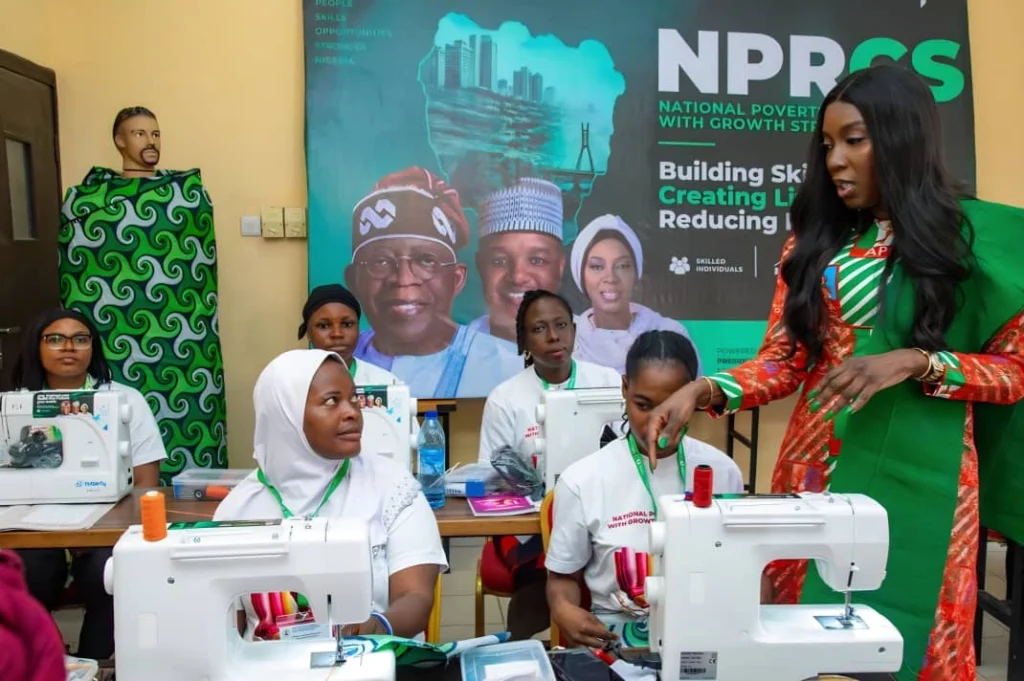
For a young Nigerian struggling to find a job, a sewing machine could provide an entry point into entrepreneurship, generate income and help support a family.
For another, a laptop could open opportunities in Artificial Intelligence (AI), graphic design and other areas of the digital economy.
These possibilities underpin the Federal Government’s National Poverty Reduction with Growth Strategy (NPRGS), which seeks to equip Nigerians with practical skills, productive tools and opportunities to earn sustainable livelihoods.
However, poverty reduction requires more than short-term interventions.
The critical question is whether such programmes can help beneficiaries establish viable businesses, secure employment and sustain their incomes.
The initiative comes against the backdrop of Nigeria’s wider skills-development challenge, as government and other stakeholders seek to bridge gaps between education, vocational training and labour-market demands.
For instance, the Federal Ministry of Education’s Technical and Vocational Education and Training (TVET) initiative reported more than 1.3 million applications, 160,000 youths matched to training and over 73,000 enrolled, alongside more than 1,700 accredited training centres.
Although these figures relate to a separate initiative, they indicate substantial demand for vocational training and underscore the need to connect training opportunities with employment and entrepreneurship.
More broadly, technical and vocational education can provide pathways into employment and self-employment.
Its effectiveness, however, depends partly on relevant courses, qualified instructors, access to equipment and links with employers and markets.
Similarly, aspiring entrepreneurs may require start-up capital, mentorship and access to customers to turn newly acquired skills into sustainable sources of income.
Against this background, the NPRGS seeks to combine vocational training with certification, productive equipment and entrepreneurship support.
At the centre of the intervention is Dr Abiola Arogundade, Senior Special Assistant to President Bola Tinubu on Technical, Vocational and Entrepreneurship Education (TVEE).
Arogundade’s work focuses on translating the administration’s Renewed Hope Agenda into practical opportunities for Nigerians through skills acquisition, entrepreneurship and technology-driven empowerment.
In support of the initiative, the Minister of Budget and Economic Planning, Sen. Abubakar Atiku Bagudu, commended the programme and reaffirmed the ministry’s commitment to interventions that align with Nigeria’s national development priorities and improve citizens’ livelihoods.
“The NPRGS is a cornerstone of our national development agenda. By focusing on skills, we’re tackling poverty at the root and unlocking Nigeria’s human capital,” he said.
The programme forms part of the administration’s broader poverty-reduction ambition.
According to the State House, the NPRGS is intended to contribute to the Federal Government’s target of lifting 100 million Nigerians out of poverty within 10 years.
Within this wider strategy, the skills intervention has a stated target of reaching five million young Nigerians.
A September 2026 report by a leading media outlet put the timeframe for that target at four years.
This distinction is important because the number of people trained or provided with equipment does not automatically translate into the number lifted out of poverty.
Explaining the objective, Arogundade said: “The objective is to lift more than five million Nigerians out of poverty.
“What we are doing, and what the President wants us to achieve is to move as many people out of poverty through skills acquisition, empowerment, entrepreneurship and technology-driven opportunities.”
To advance these objectives, the programme combines vocational trades with digital skills, offering participants different routes into employment and self-employment.
Its training areas include digital technology, fashion design, makeup artistry, solar installation and agriculture-related enterprises, reflecting the range of skills through which beneficiaries could pursue income-generating activities.
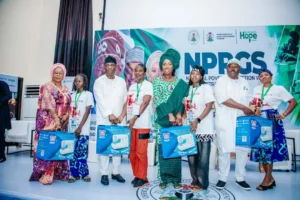
In Abuja, more than 300 beneficiaries received training in cybersecurity, web development and solar installation, alongside laptops and certificates.
Beyond the FCT, the programme has extended to Oyo State, with Enugu and Kebbi among the next locations planned for implementation.
The Oyo State phase further demonstrated the programme’s combination of technical instruction and practical empowerment to help beneficiaries apply their newly acquired skills.
At the programme’s graduation ceremony in Ibadan on Oct. 9, 700 beneficiaries were empowered through its training and digital empowerment components.
At the event, Arogundade urged beneficiaries to extend the benefits of the intervention to others, emphasising the potential for knowledge-sharing to multiply its impact.
“Don’t use it as a one-man solution or one-man empowerment. There’s a multiplier effect. Train your neighbours, train your community people, and also continue to impact and learn more,” she said.
Beyond the programme’s overall figures, participants’ experiences offer an insight into how the training could influence their career paths and livelihood prospects.
Miss Balikis Soliu, a makeup artistry participant and University of Ilorin mathematics graduate, said the opportunity had opened a new path towards entrepreneurship and an improved livelihood.
Although she already had some basic knowledge of makeup before the training, Soliu said the theoretical and practical sessions had greatly expanded her skills and understanding.
“It has been a very interesting journey and a genuine transfer of knowledge,” she said.
According to Soliu, the trainers ensured that participants acquired practical skills to help them establish successful careers in the beauty industry.
“I teach mathematics. So now, combining teaching and makeup artistry will help me because I have been living only on salaries.
“I can’t wait to own my own space and become a very good makeup artist,” she said.
Similarly, another participant, Mr Akintunde Fabiyi, a teacher of Mathematics and Science, said the technology training had broadened his understanding of digital tools, graphic design and AI.
He said he had been exposed to new concepts and technological tools, especially design software for creating professional designs and developing brands.
In addition, Fabiyi highlighted the importance of AI, noting that he now understood how to apply emerging AI tools in graphic design efficiently and productively.
He commended President Bola Tinubu for his effectiveness, adding that participants had already covered significant areas of technology and design within seven days.
Nevertheless, Fabiyi acknowledged that the 10-day training period could not accommodate every aspect of the programme’s syllabus.
He said this had reinforced the need for participants to remain committed to continuous learning and skill development after the training.
Fabiyi said he planned to “level up and scale up” by practising the skills acquired consistently, learning new techniques and taking advantage of available opportunities.
He said his goal was to improve his professional prospects and income while contributing to society and serving as a good ambassador of Nigeria.
For Mr Ogunyemi Aduragbemi, a fashion design trainee, the programme offered an opportunity to return to a trade he had previously practised.
Aduragbemi said he had left fashion design for trading because he could not afford the necessary equipment.
Consequently, he expressed excitement about receiving equipment at the end of the training, saying this would enable him to combine trading with fashion design and improve his income.
Meanwhile, the Olubadan of Ibadanland, Oba Rashidi Ladoja, commended Arogundade and the Federal Government for the initiative, calling it a game changer in efforts to reduce poverty.
“It’s a very good initiative, and we are very proud of Arogundade and this initiative.
“I would also like to encourage many people in her position to emulate her, because this will go a long way in empowering people and reducing poverty in our society,” the Olubadan said.
The programme is also expected to extend to Enugu and Kebbi states, broadening access to vocational and technology-based training.
In Enugu, Gov. Peter Mbah has pledged support for the programme ahead of its planned entry into the Coal City on Oct. 28.
The governor acknowledged the programme’s potential to expand economic opportunities and generate wider development benefits.
In addition to vocational training for young people, the intervention promotes digital inclusion through technology-based learning opportunities for students.
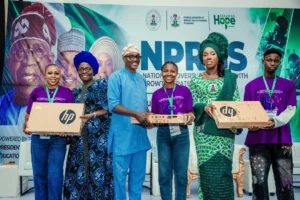
More than 100 HP laptops have been provided to schools, alongside training opportunities in robotics and AI.
Beneficiary institutions include Government Secondary School, Tudun-Wada, Wuse Zone 4, and Government Science and Technical College, Garki, Abuja.
Through these activities, the initiative seeks to expose students to technologies that could support future employment, entrepreneurship and innovation.
Nevertheless, access to equipment and introductory training alone may not guarantee sustained participation in the digital economy.
Continued learning, mentorship and opportunities to apply acquired skills will also be important.
Similarly, vocational training may not automatically translate into stable earnings without access to start-up capital, customers, suitable working conditions and markets for beneficiaries’ products and services.
These considerations are important in assessing the programme’s poverty-reduction ambitions, especially as implementation expands to more states and reaches different groups of Nigerians.
For the Tinubu administration, the target of lifting more than five million young Nigerians out of poverty is substantial.
Achieving it will require sustained implementation, effective partnerships and measurable results.
Consequently, the programme’s long-term success will depend on whether training translates into productive work, viable businesses and lasting improvements in household livelihoods.
Arogundade’s approach brings together skills development, equipment provision, business grants and evaluation, potentially strengthening the link between empowerment initiatives and measurable economic outcomes.
From sewing machines and makeup kits to laptops and solar technology, the strategy seeks to provide practical resources through which beneficiaries can pursue productive livelihoods.
While Arogundade has urged beneficiaries to extend their skills to others, the wider test of the NPRGS will be whether the training translates into sustainable livelihoods.
As the programme expands to more states, its impact will depend on beneficiaries’ ability to apply their skills, establish viable businesses and secure reliable sources of income.
Tracking these outcomes will be essential to determine how far the intervention is contributing to the Federal Government’s poverty-reduction objectives.
Ultimately, the programme’s value will lie not only in the number of Nigerians trained, but also in the economic opportunities they create for themselves, their families and their communities. (NANFeatures)
Edited by Tosin Kolade
***If used, credit the writer and the News Agency of Nigeria.



Comments