


By Angela Atabo/Justina Auta
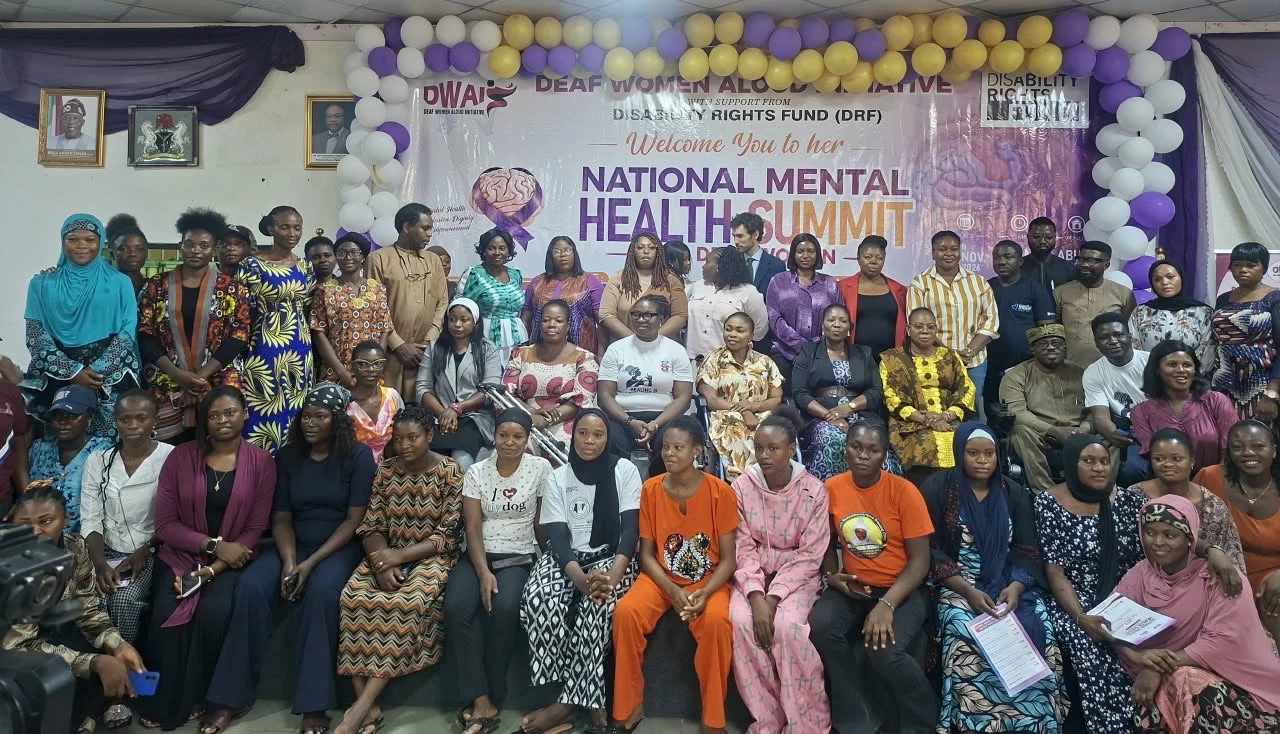
Stakeholders have called for accessible and inclusive mental health services for deaf women and girls, urging healthcare providers to address communication barriers, stigma, abuse and discrimination.
They made the call at a National Mental Health Summit for deaf women and girls organised by the Deaf Women Aloud Initiative (DWAI) on Thursday in Abuja.
The summit had the theme, “From Stigma to Solution: Advancing Mental Health and Psychosocial Wellbeing for Deaf Women”.
The Executive Director of DWAI, Mrs Hellen Beyioku-Alase, said deaf women and girls faced emotional distress, trauma and abuse but often struggled to access appropriate mental health support.
She said many mental health facilities were not equipped to meet their communication needs, limiting access to counselling and other support services.
Beyioku-Alase said DWAI had shared mental health awareness videos in Nigerian Sign Language and organised healing circles where deaf women could share their experiences.
She recounted cases of women who had experienced trauma and abuse, including a woman who lost her hearing and an arm in an accident but received no counselling or therapy.
According to her, the National Mental Health Act, 2021, mentions sign language only in relation to consent for treatment without making specific provisions for interpreters in mental health facilities.
“In countries like the UK and USA, best practices mean having doctors who can sign, of providing specialised, Deaf-led counselling. We can do this in Nigeria too.
“So today, we move from stigma to solution. We demand four things: First, sign language interpreters in all public mental health facilities. Second, train mental health workers in basic sign language and Deaf culture.
“Third, fund mental health information in sign language. Fourth, enforce the Disability Act to stop the abuse of our women,” she said.
She said Nigeria had the necessary laws and evidence to improve access to mental health services but required stronger government action to implement them.
The National Coordinator, National Mental Health Programme, Dr Tunde Ojo, said stigma and discrimination undermined trust and discouraged people from seeking mental healthcare.
Ojo, represented by Mrs Grace Adedunmade, Assistant Director of Nursing Services, said the Federal Ministry of Health and Social Welfare had advanced implementation of the National Mental Health Act and revised the National Mental Health Policy in 2023.
He said the ministry had also integrated mental health services into primary healthcare through the adaptation of the World Health Organisation’s Mental Health Gap Action Programme, known as mhGAP 3.0.
Ojo stressed the need for healthcare providers to ask deaf women about their preferred communication methods, protect their confidentiality and ensure accessible referral pathways.
He urged stakeholders to involve deaf women and girls in designing and evaluating mental health services.
Also speaking, Mr Diego Martin of the Embassy of Spain reaffirmed his country’s commitment to human rights and the promotion of the rights of persons with disabilities.
Martin said Spain supported the principles of the 2006 Convention on the Rights of Persons with Disabilities, which recognised persons with disabilities as full rights holders.
He commended DWAI for organising the summit and urged participants to ensure that their discussions promoted inclusive mental health services for deaf women and girls.
Ms Ramatu Ochekliye, Founder of Shades of Us, said storytelling and film could challenge stereotypes and improve understanding of the experiences of persons with disabilities.
Ochekliye said her organisation was partnering with DWAI to make mental health information accessible through Nigerian Sign Language and create safe spaces for shared experiences and psychosocial support.
She said the organisation’s film, “The Dumps”, addressed mental health and suicidal ideation, while its Mobile Cinema project took films and community discussions to different communities.
The Director-General of the National Agency for the Prohibition of Trafficking in Persons (NAPTIP), Mrs Binta Bello, said deaf women were vulnerable to trafficking, abuse and exploitation because of communication barriers.
Bello, represented by her Technical Assistant, Mr Timothy Timat, recounted the case of a Nigerian deaf woman who was trafficked across several African countries and subjected to abuse before she was rescued and returned to Nigeria.
She said NAPTIP had adopted an open-door policy for persons with disabilities, supported by its disability policy, to ensure that deaf women could access assistance without communication barriers.
Bello said the principle of “nothing about us without us” should guide policies and programmes affecting persons with disabilities. (NAN)
Edited by Tosin Kolade

Comments