


By Mercy Sawok
Stakeholders in Nigeria’s health sector have called for urgent reforms of public health laws across states to strengthen the country’s capacity to prevent, detect and respond effectively to epidemics and public health emergencies.
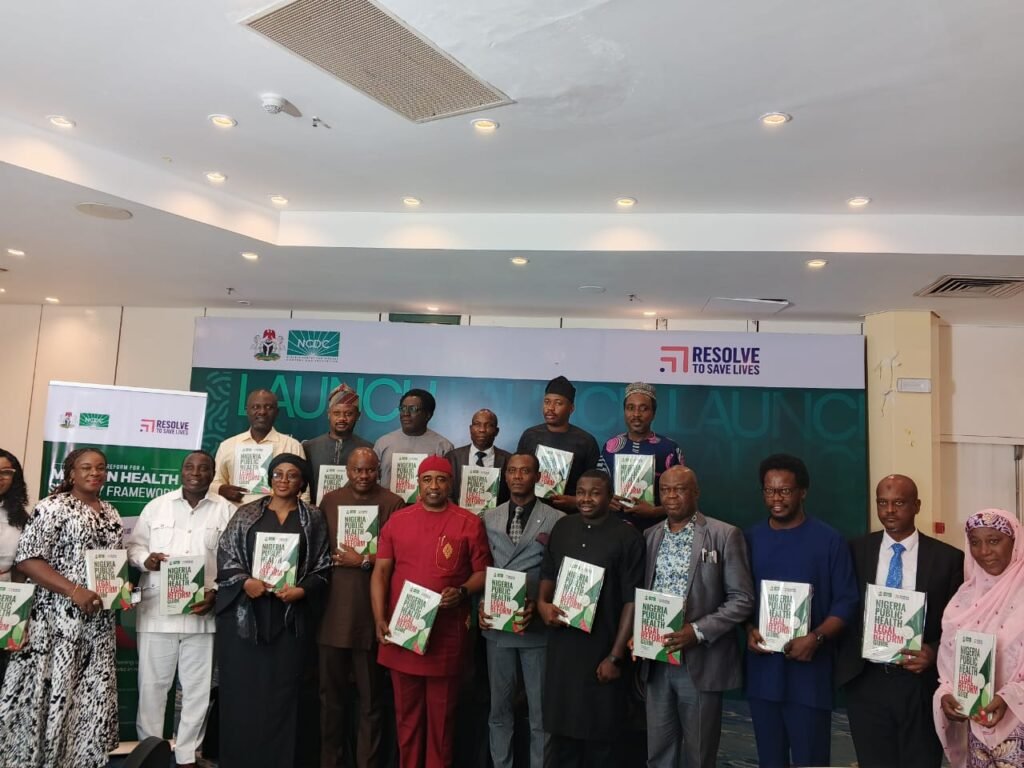
The call was made on Wednesday in Abuja during the inauguration of the Nigeria Subnational Public Health Legal Reform Guide, a practical framework designed to help states review laws and strengthen health security.
The Interim Country Director of Resolve to Save Lives (RTSL), Dr Jenom Danjuma, said strong public health institutions could only function effectively when supported by strong legal foundations and governance frameworks.
Danjuma described the initiative as a major milestone in strengthening public health legal preparedness, explaining that preparedness involved using laws to build systems capable of preventing, detecting and responding to outbreaks.
He traced the initiative to a national legal assessment conducted in 2019, which identified gaps in Nigeria’s public health legal framework and underscored the need for state-level legal reviews.
According to him, Nigeria’s federal structure distributes public health responsibilities among federal, state and local governments, making state-level legal preparedness a critical component of national health security efforts.
“It provides governments with a clearer pathway from legal assessment to reform, and then from reform to implementation,” Danjuma said.
He also highlighted the importance of structured legal reform processes.
“Most importantly, it also recognises that public health legal reform is not only the responsibility of lawyers.
“It is also a collective leadership that involves public health professionals, policymakers, legislators, regulators, communities and other stakeholders working together towards a shared objective of keeping Nigeria safe from epidemics.”
He always emphasised the need for broader stakeholder engagement nationwide
Danjuma said that although some states had made progress, there remained significant opportunities to expand and accelerate legal reforms across the country to strengthen health emergency preparedness systems.
He described the guide as a standardised yet adaptable framework that states could modify to suit their legal, institutional and public health realities while pursuing effective reforms.
Also speaking, the Director-General of the Nigeria Centre for Disease Control and Prevention (NCDC), Dr Jide Idris, said states carried substantial responsibilities for protecting public health nationwide.
Represented by Dr Evaristus Aniaku, Deputy Director and Public Health Emergency Management Specialist, Idris said the guide would support efforts to modernise state public health legal structures.
He said reforms would help states keep pace with emerging and re-emerging diseases, technological developments, evolving institutions and Nigeria’s obligations under the International Health Regulations (2005).
According to him, legal reform extends beyond passing new laws to clarifying institutional mandates, improving surveillance and reporting systems, and enabling effective public health operations nationwide.
Idris identified sustainable financing for health security at the state level as a major challenge confronting subnational preparedness and emergency response capacity across the federation.
He expressed hope that the reform process would strengthen state public health operations centres, surveillance systems, emergency response personnel and incident management structures across Nigeria.
The NCDC Director-General commended RTSL, technical experts, government institutions and development partners for their contributions to developing the guide and advancing public health preparedness efforts.
The Chairman, House of Representatives Committee on Healthcare Services, Mr Amos Magaji, said effective public health service delivery required an appropriate legal framework to support implementation nationwide.
Represented by Mr Bassey Akiba, Magaji urged health practitioners and professionals working with communities to identify legislative gaps and propose amendments or new laws where necessary.
According to him, practitioners confronting public health challenges are well positioned to provide lawmakers with practical evidence needed to shape reforms and improve service delivery outcomes.
He added that such proposals could be channelled through the relevant committees of the National Assembly for consideration and possible legislative action to strengthen public health governance.
Presenting an overview of the guide, NCDC Legal Adviser to RTSL, Safiya Musa, said it explained Nigeria’s constitutional and legal framework and available governmental legal instruments.
Musa said the guide also outlined the legislative process, including first and second readings, committee consideration, third reading and implementation following enactment of legislation by states.
She said that post-legislation activities such as dissemination, public awareness, capacity building, enforcement and periodic review were essential for ensuring laws achieved their intended objectives.
According to her, practical resources contained in the guide include a subnational legal assessment tool, legal mapping tool, model public health security bill and drafting guidance.(NAN)(www.nannews.ng)
Edited by Abiemwense Moru


Comments