


By Maureen Okon
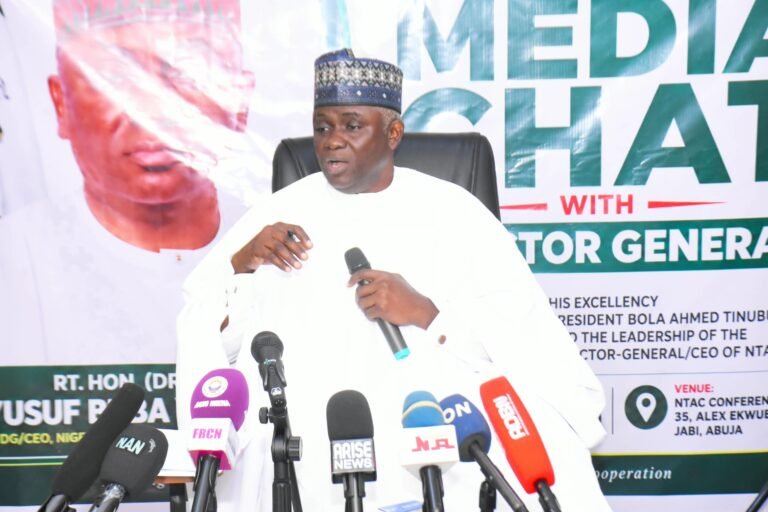
Dr Yusuf Yakub, Director-General (D-G) of the Nigeria Technical Aid Corps (NTAC), says the corps, under President Bola Tinubu’s 4D policy, has been repositioned as a practical instrument of Nigeria’s soft power diplomacy.
The director-general said this during the presentation of the agency’s three-year scorecard at a media chat held at the corps’ headquarters in Abuja.
Yakub lauded Tinubu for the confidence reposed in him since his appointment in Aug. 2023, while commending the Presidency, the Ministry of Foreign Affairs, the National Assembly Committees on Foreign Affairs, Nigeria’s diplomatic missions abroad, and NTAC staff for their support.
He said the engagement was significant because the media remained a critical partner in informing Nigerians and the international community about the activities of government institutions.
Yakub noted that NTAC, established in 1987, had deployed over 10,000 Nigerian professionals to more than 40 countries in Africa, the Caribbean and the Pacific (ACP) in the last 38 years.
He said the fields in which Nigerian professionals were most requested included education, medicine, engineering, agriculture, and science and technology.
He said that under Tinubu, the corps had been given renewed vigour and strategic direction in line with the 4D foreign policy framework, which includes Democracy, Development, Demography and Diaspora.
He added that the 4D policy informed his own 3R Agenda of Repositioning, Retooling and Re-engineering NTAC.
The D-G listed key achievements, saying the revitalisation of the Technical Aid Corps (TAC) Scheme had renewed national consciousness about technical assistance as an instrument of diplomacy.
He said the corps had sustained regular deployment of professionals, with returning volunteers received in 2026 from Guinea-Bissau, Liberia, Sierra Leone and The Gambia after completing their two-year assignments.
On improved welfare, Yakub said the administration prioritised prompt payment of allowances, accommodation and welfare, as well as monitoring, debriefing and reintegration of volunteers.
“Every naira spent on the TAC scheme ultimately represents an investment in a Nigerian serving Nigeria’s international interest,” he said.
Yakub cited the growing visibility of Nigerian volunteers occupying positions of responsibility.
In The Gambia, he said, volunteers had contributed to education, administration, legal and medical systems, which prompted a recent thank-you visit to NTAC by The Gambia Minister for Higher Education.
He added that Nigerian lecturers had been appointed as vice-chancellors, deputy vice-chancellors, deans and heads of department in host universities.
On strengthening soft power diplomacy, he said diplomacy happens beyond conference rooms.
He cited the example of a Nigerian nurse in Guinea-Bissau who delivered a baby under difficult conditions – the baby was named “Nkiruka” after her – and a Nigerian agricultural expert in Uganda who transformed banana fibre into building materials.
According to him, NTAC is repositioning technical assistance from a one-way relationship into a platform for mutually beneficial cooperation, where Nigeria both gives and receives knowledge.
Yakub said NTAC was exploring structured arrangements for countries that require Nigerian expertise to engage professionals for a fee, to discourage irregular migration, locally called the “Japa Syndrome” through deserts and oceans.
“That is the Nigeria we want to see — what NTAC has just put on the table by talking to countries that have already developed confidence in Nigerians through the NTAC scheme.
“They are also asking for Nigerians to come and work in those countries, willing to pay and package them with dignity,” he said.
On institutional and infrastructural repositioning, he disclosed that NTAC headquarters, which was dilapidated when he assumed office, had been remodelled and refurnished, with new vehicles acquired to support operations and visiting diplomats.
He added that the corps had commenced training programmes for officers and Foreign Service officials, while debriefing of returning volunteers had become a core component to document lessons and feed into national human capital development.
Yakub said NTAC’s work had helped reverse Nigeria’s perception from being only a recipient of Sustainable Development Goals (SDG) support to being recognised as a major contributor, through its deployment of technical manpower to ACP countries.
He said the message he kept giving volunteers was to be good ambassadors of Nigeria.
“You are not merely going abroad to work; you are going abroad to represent Nigeria, and you are Nigeria,” he said.(NAN)(www.nannews.ng)
Edited by Emmanuel Yashim
Comments