


By Usman Aliyu
A coalition of African civil society organisations has rejected efforts to incorporate the continent’s wildlife and natural habitats into global carbon markets, describing the move as a new form of colonialism.
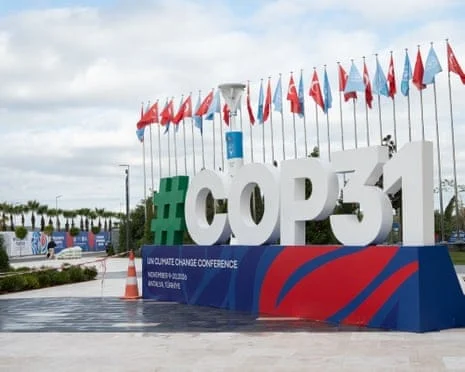
The organisations stated this in a joint statement issued at the UN Climate Change Summit in Antalya, Türkiye, and made available to the News Agency of Nigeria (NAN) on Tuesday.
The statement was endorsed by organisations across Africa, including the No REDD in Africa Network, Health of Mother Earth Foundation (HOMEF), Oil watch Africa, Oil watch International, Power Shift Africa, and Corporate Accountability and Public Participation Africa (CAPPA).
Others included the West African Climate Justice Movement, Connected Advocacy, Oil watch Nigeria, Justice Environmental, Policy Alert and the African Climate Justice Collective.
The coalition maintained that wildlife conservation should not be used to create carbon credits that allow major polluters, particularly in the Global North, to offset their greenhouse gas emissions.
Entitled “Lions are Africa’s Kings, NOT Europe’s Carbon Dump,” the organisations argued that Africa’s wildlife and ecosystems should not become instruments for corporate profit or a substitute for reducing emissions at source.
“We will not allow Africa and our spectacular wildlife to be put into carbon markets so Europe can pretend to offset its increasing emissions and grab our continent for more extractives, slavery and exploitative safaris.
“Our lions are Africa’s kings; their habitat is not Europe’s carbon dump. Our elephants are our gentle giants; their forests are not corporations’ carbon sinks,” the groups said.
The civil societies expressed concern over what they described as attempts to integrate wildlife conservation into global climate policy through carbon offset schemes.
They cited an October 2026 resolution by the European Parliament calling for the formal integration of wildlife conservation into global climate policy, arguing that such an approach could turn the habitats of Africa’s iconic and migratory wildlife into carbon offset projects.
The coalition also criticised REDD+ projects, which seek to reduce emissions from deforestation and forest degradation.
Some of the projects, they alleged, could enable resource extraction while undermining national sovereignty, customary land rights and the rights of local communities, particularly women.
The coalition warned that such initiatives could restrict communities’ control over their lands and natural resources without adequately addressing their interests.
On nature-based financial instruments, the organisations criticised the World Bank’s Rhino Bond prototype and debt-for-nature swaps, describing them as mechanisms that could promote private investors’ profits and deepen Africa’s dependence on external financing.
“Clearly, putting a price on nature does not save nature; it pimps her for Wall Street’s financial speculation,” the groups said.
They maintained that carbon offsets based on ecosystems and wildlife habitats were not a substitute for reducing greenhouse gas emissions at source.
The coalition argued that the assumption that nature could indefinitely absorb carbon dioxide was flawed, citing studies which, according to the statement, indicated that nature’s capacity to absorb gas had peaked nearly 20 years ago.
They also cited reports that the world’s forests ceased to be carbon sinks and became carbon sources in both 2023 and 2024.
The organisations therefore called on the Conferences of the Parties to the United Nations Framework Convention on Climate Change (UNFCCC) to abandon the development of global carbon markets based on the commodification of nature, including wildlife offsets and REDD+ schemes under Articles 5 and 6 of the Paris Agreement.
They also urged governments to take immediate steps to cut greenhouse gas emissions at source and phase out fossil fuels.
“Nature must not be turned into nature bonds because she is the source of life, and feeds our peoples,” the organisations said.
The groups further called on the UN Special Committee on decolonisation to broaden its mandate to address what they described as carbon colonialism.
They said Africa’s struggle against colonialism should inform resistance to climate policies that could transfer control of its natural resources to foreign interests.
“Our Lion King does not belong to carbon traders to sell ‘Lion Carbon’. Our Lion King belongs to Africa, and is our symbol, pride and heritage,” they added.
(NAN)
Edited by Nick Nicholas

Comments