


By Joan Nwagwu
The Medical and Health Workers’ Union of Nigeria (MHWUN) says women constitute 67.2 per cent of the global health workforce but remain underrepresented in leadership.
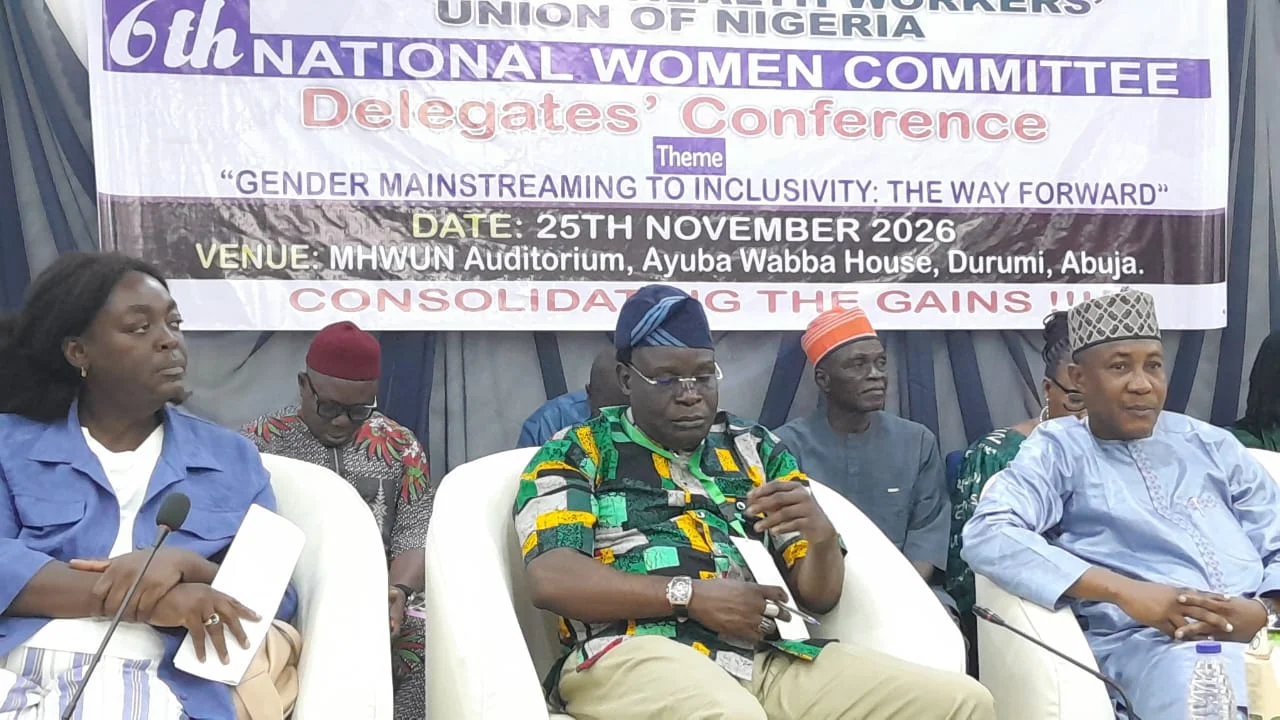
The union’s National President, Mr Kabiru Sani, said this on Wednesday in Abuja at the 6th National Women Committee Delegates’ Conference.
Sani said women occupied only about a quarter of senior leadership positions in spite of their significant contribution to the global health and care workforce.
He urged women to translate gender mainstreaming into inclusive leadership, greater participation and meaningful contributions to decision-making.
He said the conference theme, “Gender Mainstreaming to Inclusivity: The Way Forward”, challenged the union to move beyond policies and slogans towards practical empowerment.
“Mainstreaming opened the door by ensuring that women are present in our structures.
“Inclusivity asks the harder question: once through that door, do women’s voices shape the agenda, is their leadership trusted, and are their contributions recognised?
“The theme of this conference is to strengthen and empower them to move beyond the borders of MHWUN,” he said.
Sani said gender mainstreaming had remained a pillar of the union’s agenda since 2003, supported through training programmes and partnerships with local and international organisations.
He recalled that Nigeria ratified the International Labour Organisation (ILO) Convention 190 on violence and harassment in the workplace on Nov. 8, 2022.
He urged stakeholders to ensure the convention’s effective implementation across the health sector.
The president also urged delegates to conduct a transparent election of new National Women Committee leaders in accordance with the union’s constitution.
“The contest ends at the ballot box, and the day after, we remain one Committee and one Union.
“I strongly believe that the new leadership that will emerge today is not just coming to be part of our developmental agenda, but to contribute meaningfully to moving the union to another level of development,” he said.
Earlier, the National Chairperson of MHWUN Women’s Committee, Mrs Cecilia Ita, called for deeper gender inclusion and equal leadership opportunities for women across the union.
“Mainstreaming got women into the room. Inclusivity asks whether every woman in that room is heard, developed and trusted to lead,” Ita said.
She said the committee had worked since 2003 to strengthen women’s representation in union structures, train women leaders and revive dormant women committees.
Ita said the committee had also promoted gender issues in collective bargaining and secured women’s participation in key union decision-making structures.
She listed the National Administrative Council, Central Working Committee, zonal structures and state councils among the platforms where women were represented.
The chairperson urged the union to establish gender focal points across branches and state councils and set measurable targets for women’s representation.
She also advocated stronger mentoring programmes to prepare younger women for leadership positions.
“Inclusivity means no woman is left on the margins of her own union. And it means our male comrades standing with us as deliberate allies,” she said.
Ita called for childcare support, nursing mothers’ facilities, predictable maternity protection, disability access standards and effective anti-harassment policies.
She said women health workers faced economic hardship, workplace harassment, precarious employment and increasing care responsibilities.
According to her, the migration of health professionals also continues to affect the sector.
Ita urged delegates to ensure free, fair, peaceful and credible elections through transparent accreditation, secret balloting, open counting and public declaration of results.
She encouraged women to mentor younger colleagues, organise contract and casual workers and build alliances to advance justice, equity and dignity.
The chairperson said gender mainstreaming was not a favour to women but a strategic necessity for strengthening the union’s credibility and effectiveness.(NAN)
Edited by Rotimi Ijikanmi



Comments