


By Folasade Akpan
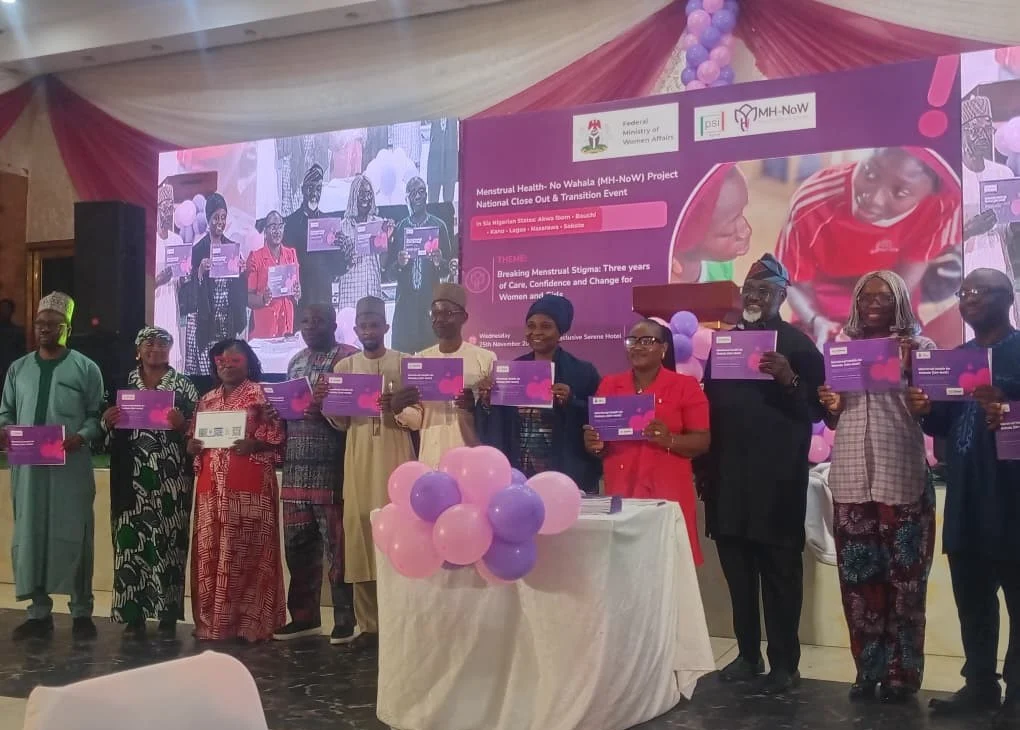
Population Services International (PSI), Nigeria, says its three-year Menstrual Health No Wahala (MH-NoW) project has reached more than 233,000 girls across six states, promoting menstrual health education.
The Country Representative of PSI Nigeria, Mr Effiom Effiom, disclosed this at the national close-out and transition event of the project on Wednesday in Abuja.
According to him, the project also promoted access to affordable products and efforts to eliminate stigma.
Effiom said the initiative was implemented in 18 local government areas across Plateau, Nasarawa, Kano, Lagos, Akwa Ibom and Bauchi States.
He said the project addressed cultural stigma, inadequate information and limited access to affordable menstrual products, while strengthening support systems in schools, communities and primary healthcare facilities.
“Change starts from giving our girls the right information about their menstrual health, building awareness from the school to the community and even the primary healthcare system,” he said.
Effiom said the project also supported a network of local menstrual product producers, with about 40 producers generating more than N63 million during the implementation period.
He said the initiative encouraged local production of affordable sanitary pads, with some products costing as little as N155, to improve access among girls and women, particularly in rural communities.
He added that menstrual pad banks were established in schools to provide immediate support to girls who began menstruating while in school.
“Most times, the first menstrual cycle happens in schools, so we needed to make sure that teachers and peer educators are able to guide the girls.
“We have in schools what we call menstrual pad banks, so that when this happens, the girls are immediately supported,” he said.
Effiom said the project also engaged men and boys to address misconceptions and promote supportive attitudes towards menstruation.
He, however, noted that eliminating stigma required sustained education and community engagement beyond the project’s three-year implementation period.
The country representative said the initiative also supported government ownership through advocacy for menstrual health budget lines, adding that N23 million had been promised by states during the project period, although some funds were yet to be released.
He said collaboration with the Federal Ministry of Women Affairs had also contributed to the development of a national policy framework to guide menstrual health interventions and provide a basis for sustained government funding.
Speaking about the project’s results and achievements, PSI Team Lead, Miss Winifred Kwaknat, said the project established six state technical working groups and engaged 300 community leaders as menstrual health advocates and champions.
She said the advocates worked across 90 schools, 90 health facilities and 90 communities to promote awareness and improve access to menstrual health services.
Kwaknat said one of the major achievements was creating stronger connections between schools, communities and health facilities, while ensuring that men and boys were deliberately included in menstrual health advocacy.
She called on state governments to domesticate the national menstrual health policy and strengthen existing technical working groups to sustain the gains recorded.
Also speaking, Ms Ngozika Igboaruka, Policy and Advocacy Manager, WaterAid Nigeria, said menstrual health could not be addressed without adequate water, sanitation and hygiene facilities, particularly in schools.
She cited a 2025 UNICEF study indicating that only 16.6 per cent of schools had gender-friendly toilets, stressing the need for governments and other stakeholders to improve sanitation facilities.
She also advocated the establishment of sanitary pad banks in public spaces, including government offices, to improve access for menstruating women.
Similarly, Dr Funke Ayeni, Head of Gender, Adolescent and School Health Division, Lagos State Ministry of Health, commended PSI for implementing the project in the state.
Ayeni said the initiative had improved awareness, reduced stigma and created opportunities for girls and women to discuss menstrual health without shame.
She said the project also empowered women economically through their involvement in the distribution of menstrual products.
According to her, Lagos State will build on the structures established by the project and extend its activities beyond the three local government areas covered during implementation.
Also, Ms Nancy Walter, Senior Environmental Health Officer, Federal Ministry of Environment, said menstrual health was fundamental to sexual, maternal and child health, as well as sanitation and hygiene promotion.
Walter called for improved access to functional sanitation facilities, particularly in schools, to enable girls to manage menstruation with dignity.
She said boys and men also had important roles to play in challenging stigma and supporting girls and women.
The News Agency of Nigeria (NAN) reports that MH-NoW project was implemented in partnership with government institutions and other stakeholders.
Its focus is on improving menstrual health knowledge, access to safe and affordable products, and sustainable community-level support systems.(NAN)
Edited by Isaac Aregbesola


Comments