










By Edith Tsokar
Prof. Samson Afolabi of the Mathematics Education, National Open University of Nigeria (NOUN) has called for a shift from rote learning to practical, technology-driven Mathematics Education.
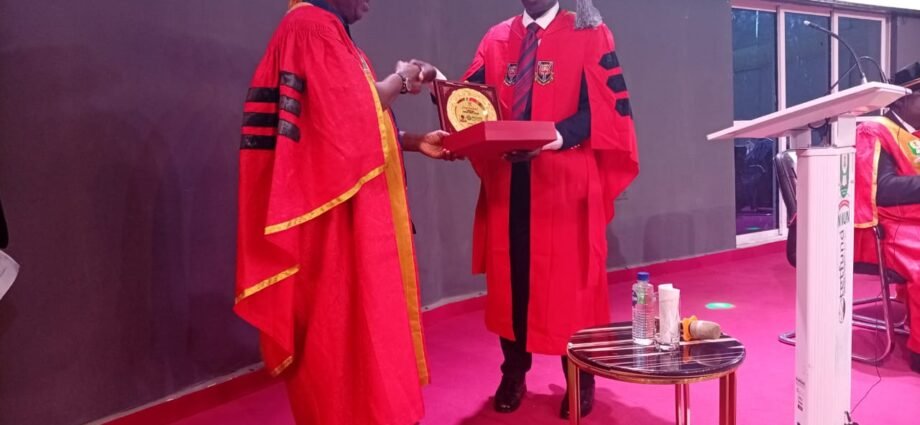
Afolabi made the call on Thursday at the 41st inaugural lecture entitled “The What, Why, Who, How, When and Where: My Storey in the Edifice of Mathematics Education,” in Abuja.
The News Agency of Nigeria (NAN) reports that the lecture highlighted the growing importance of instructional resources, cloud computing, mobile learning and social media as tools for improving students’ attitude toward mathematics and expanding learning opportunities beyond the classroom.
He said the approach would help in promoting critical thinking, peace, innovation and sustainable national development in the country.
He said that mathematics remained a strategic instrument for scientific advancement, economic growth and sustainable national development.
He further said Mathematics Education should move beyond formulas and classroom theories to hands-on experiences that enable learners to solve real-life problems while developing values needed for peaceful coexistence.
According to him, effective mathematics teaching should integrate cognitive, affective and psychomotor learning domains, arguing that values such as truthfulness, discipline, tolerance and honesty are essential ingredients for peace and national development.
The professor warned that neglecting the affective aspect of learning could produce knowledgeable graduates who lack moral values and social responsibility.
He also advocated teaching methods that encourage educators to embrace innovation, saying the COVID-19 pandemic demonstrated the need for teachers to teach beyond their existing knowledge through digital collaboration and emerging technologies.
The scholar said studies conducted over the years showed that the frequency of mathematics study rather than gender was a stronger predictor of academic achievement, challenging long-held stereotypes about the subject.
He stressed that Nigeria required transformational teachers capable of inspiring inquiry, collaboration, creativity and problem-solving instead of relying on conventional lecture methods.
The professor distinguished between mathematicians and mathematics educators, explaining that while mathematicians focused on expanding mathematical knowledge, mathematics educators were trained to improve the teaching and learning of mathematics.
“While mathematicians work in universities, research institutes, industries and government, it is an aberration to find mathematicians working in schools and colleges and it’s a misfit.
“They differ in their goal, they differ in their output, they differ in their audience, they differ in the example of activities or what they do.
“A mathematics educator is trained in philosophy, psychology and pedagogy of teaching and learning while a mathematician is trained in advancing mathematics knowledge, the objectives also differ.
“The mathematical education is to develop a total mind, cognitive, affective and psychomotor domain,” he said.
Afolabi advocated early exposure to mathematics, regular daily study and timely interventions across all levels of education to strengthen learners’ competence and prepare them for global competitiveness.
According to him , mathematics education should not be restricted to conventional classrooms but extended to laboratories, virtual environments and real-life settings where learners can apply concepts meaningfully.
He also stressed that technology integration, democratic leadership and institutional innovation were essential for improving access, equity and quality in education.
He called for harmonised international standards for evaluating academic output, saying such a framework would promote fairness and strengthen Nigeria’s competitiveness in global scholarship.
Afolabi appealed to the university management to establish a doctoral programme in Mathematics Education, noting that the absence of the programme had compelled many graduates to seek further studies elsewhere.
He maintained that mathematics, when taught through innovation, inclusiveness and practical application, became a strategic tool for transforming individuals, institutions and nations.
He noted that adopting learner-centred approaches would reduce mathematics anxiety, strengthen critical thinking and prepare graduates with skills required in the 21st century knowledge economy.
“This is why mathematics education is not optional. It is essential for national progress and global survival.
“Collectively, my research has contributed immensely to the world of mathematics education by demonstrating that mathematics education is essential for national development and technological advancement.
“It is essential for the development of critical thinking, creativity, and problem-solving abilities, EQ planners with 21st century competencies, analytical thinking, creativity, collaboration, adaptability.
“These are the foundation of global competitiveness- reducing mathematics anxiety and cognitive barriers, improves workforce preparedness, fosters innovation and collaborative learning, and EQ planners with competencies required for sustainable development in the 24th century.”
Afolabi reiterated that mathematics education was not merely about numbers but about building confident learners, strengthening teacher education and driving national development through knowledge, creativity and innovation.
Earlier, the Deputy Vice-Chancellor, Technology, Innovation and Research, Prof. Christine Ofulue, who represented the Vice-Chancellor, Prof Uduma Uduma, described inaugural lectures as important academic traditions that celebrate scholarship and demonstrate the impact of research on society.
She acknowledged that mathematics had traditionally been perceived as a difficult subject, attributing the challenge partly to ineffective teaching methods.
Ofulue expressed optimism that the lecture would provide fresh insights into improving mathematics teaching and learning in Nigeria. (NAN) (www.nannews.ng)
Edited by Funmilayo Adeyemi