


By Philomina Attah
Former Kaduna State Governor, Dr Mukhtar Yero, has appealed to the Institute for Humanitarian Studies and Social Development (IHSD) to strengthen partnership with State Emergency Management Agencies (SEMAs) across Nigeria.
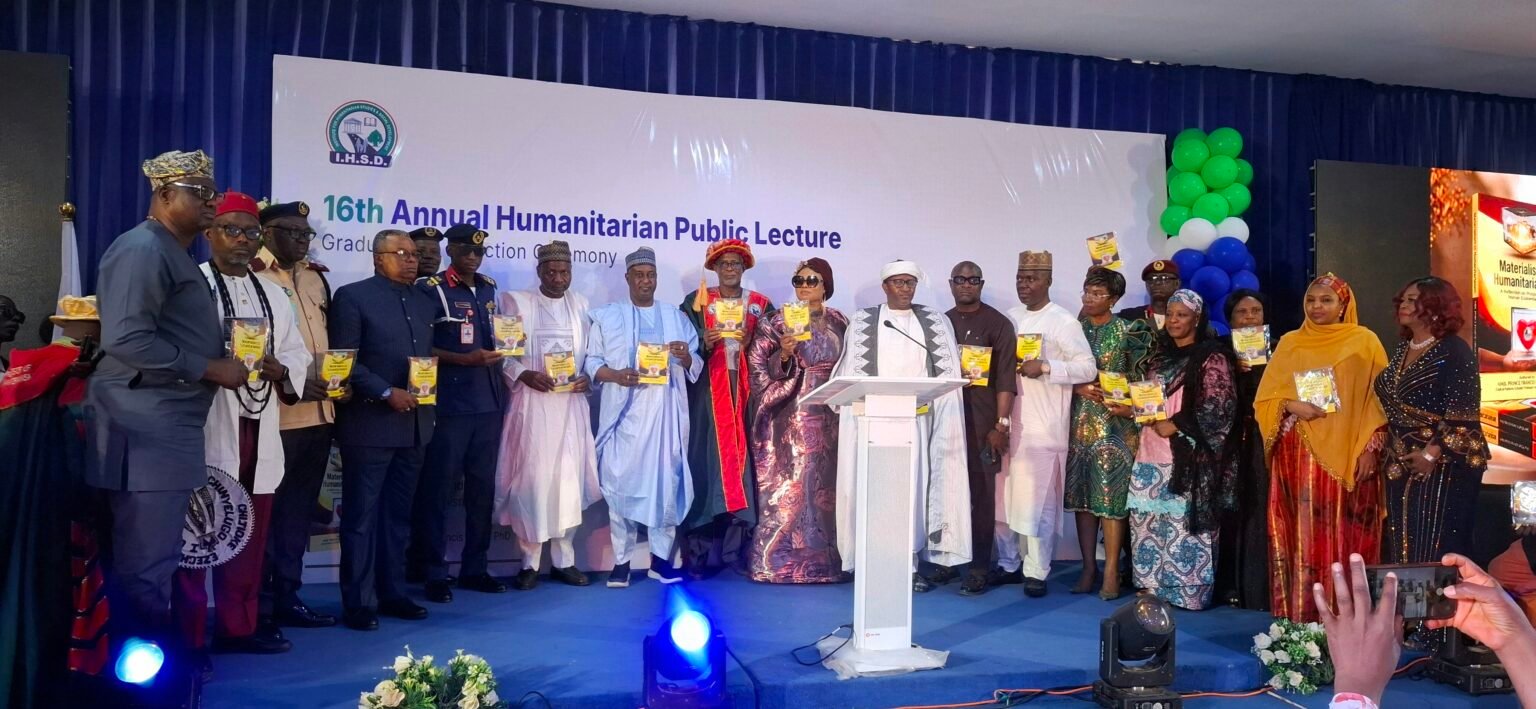
Yero made the appeal while delivering an address as Chairman of the 16th IHSD Humanitarian Public Lecture and Induction Ceremony in Abuja on Saturday to commemorate World Humanitarian Day (WHD) 2026.
The event, themed “Resilience in Action: Strengthening Ethical Leadership, Inclusivity and Humanitarian Values in Nigeria,” brought together key institutional leaders, socio-political actors, and international development partners.
According to him, collaboration with SEMAs will help extend structured humanitarian activities directly to local government councils, where vulnerable populations face the most pressing challenges.
The former governor encouraged newly inducted fellows to put their training into active practice, emphasising that professional awards and recognition must lead to sustained community impact rather than ending with the ceremony.
To drive continuous organisational growth, Yero recommended establishing a standing Fellows’ Conference or specialised committees to offer a permanent platform for fellows to contribute their expertise.
He urged the IHSD management to expand its footprint nationwide, stressing that expanding participation beyond current states would ensure all geopolitical zones benefit from humanitarian education, advocacy, and community engagement.
Keynote Speaker, Prof. Kalu Uche, Deputy Vice-Chancellor (Administration), Gregory University, Uturu, Abia State, described institutional corruption as a major crime against human dignity.
The don urged anti-graft agencies to treat corrupt public officials as perpetrators of humanitarian crimes.
Speaking on the theme “Strengthening Humanitarian Ethics and Values in Leadership,” he criticised political patronage disguised as humanitarian aid during election cycles, warning that such acts undermined human dignity and real development.
He called on tertiary education regulatory bodies, including the National Universities Commission (NUC) and the National Board for Technical Education (NBTE), to integrate humanitarian curricula across primary, secondary, and tertiary schools to curb cultism, bullying, and societal decay.
Highlighting the core ethical pillars of humanity, impartiality, and independence, the don urged leaders in governance to place human life and public welfare at the centre of all legislative and economic policies.
Uche further advocated for universal social safety nets, including effective student loans, reliable employment insurance, and healthcare access, urging strict enforcement of existing protective laws to safeguard vulnerable Nigerians.
IHSD Registrar, Francis Origa, reminded newly inducted fellows that their certification placed a moral responsibility on them to serve as principled ambassadors of goodwill in their communities.
”We have trained and certified them to serve as humanitarian ambassadors of goodwill and integrity. Their responsibility is to exemplify the values they have been taught,” he said.
He stressed that preaching humanity must be matched with personal conduct.
”When we preach humanity and humanitarianism, it must be reflected in our own conduct. We expect them to be of good character and worthy ambassadors of the institute,” he noted.
Reviewing the book “Materialism and Humanitarianism” authored by Origa, Dr Ahmed Saidu Ey-Shaa of the National Commission for Mass Literacy, Adult and Non-Formal Education, noted that the excessive pursuit of money has severely eroded traditional social values and integrity.
He said global wealth inequality remained stark, with one per cent of the world population controlling vast resources while over 750 million people live in extreme poverty, proving that human suffering stems from unequal distribution and greed rather than absolute scarcity.
Citing Chinua Achebe and former U.S. President Barack Obama, the reviewer stressed that Africa’s true hurdle was a lack of strong, independent institutions rather than a shortage of powerful leaders.
Ey-Shaa criticised state governors for weakening local government administration and undermining traditional authorities, arguing that real humanitarian development must begin by restoring financial autonomy to local communities.
He urged civil society organisations, the judiciary, and citizens to actively defend institutional integrity, balance the quest for material gains, and uphold core values of compassion, hard work, and honesty.
Earlier, IHSD Governing Council Chairman, Adamu Ibrahim, in an address of welcome, reaffirmed the institute’s commitment to providing critical policy solutions to Nigeria’s evolving security and socio-economic challenges in collaboration with the United Nations Institute for Training and Research (UNITAR).
The ceremony featured the unveiling of the institute’s new “Humanitarian 4.0” initiative and logo, alongside the induction of humanitarian fellows.
It also featured the presentation of awards to distinguished figures, including former First Lady Patience Jonathan, recognised as the Humanitarian Amazon of the Year, and HRM Apostle Chibuzor Gift Chinyere.(NAN)(www.nannews.ng)
Edited by Mark Longyen

Comments