


By Funmilola Gboteku
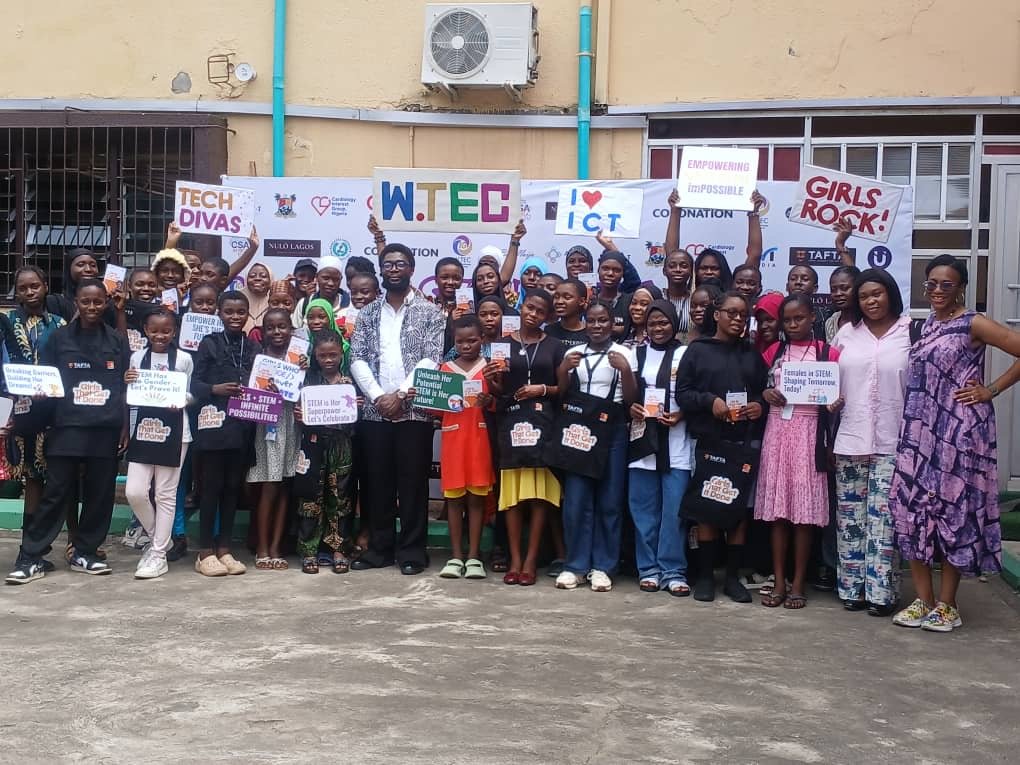
The Women’s Technology Empowerment Centre (W.TEC) says it has intensified efforts to equip girls with practical technology skills needed to become creators, innovators and problem solvers.
Mrs Oreoluwa Lesi, Founder and Executive Director, W.TEC, said this in an interview with the News Agency of Nigeria (NAN) on Thursday in Lagos.
Lesi noted that the centre’s 2026 ‘She Creates Camp’ was designed to move girls beyond consuming technology to creating solutions with it.
She said the curriculum had evolved to include Artificial Intelligence (AI), cybersecurity, content creation, filmmaking, electronics and other hands-on technology activities.
“This year our focus is AI, but the curriculum has really changed from last year. There is a lot more content creation and using AI to support generating scripts,” she said.
According to her, the girls are also learning to apply AI to filmmaking while developing practical projects that allowed them to turn ideas into tangible solutions.
She explained that the hands-on component remained central because participants needed opportunities to experiment, build and understand how technology could address real problems.
Lesi said cybersecurity was also included because of the growing risks young people faced online, adding that participants were taught ways to protect themselves and use the internet safely.
“Especially when people are going online at a younger age now, it is very important to make sure they are able to use the internet safely and wisely,” she said.
On W.TEC’s broader mission, Lesi said the centre was working to narrow the gender gap by nurturing more female technology creators, innovators and builders.
She noted that W.TEC had expanded its programmes beyond technology to incorporate science, engineering principles and mathematics.
According to her, women remain significantly underrepresented in STEM education and employment, as well as emerging fields such as AI.
“If women are not participating in this space, we are being left behind and we are not having any influence on creating and shaping the technologies we are going to use,” she said.
Lesi stressed that W.TEC wanted girls to start thinking about how they could use STEM to innovate and solve problems within their communities.
She said the two-week residential camp was structured to combine technical training with excursions and activities aimed at building confidence and leadership skills.
“By the time you see a girl on her first day and then see her on graduation day, there will always be a change,” she said.
On access, Lesi said the 2026 camp attracted 43 girls, with most participants sponsored by corporate organisations and private individuals.
She said LTT Marine and Coastal Services sponsored 20 girls from communities around Tincan Island and Apapa, while Alaro City sponsored 18 girls from Epe.
Lesi noted that the sponsored participants were drawn from public schools, where access to functional technology facilities was often limited.
“These are girls who would not normally have access to this kind of opportunity in their schools,” she said.
On the girls-only structure, Lesi said the approach was deliberate because social expectations could sometimes discourage girls from actively participating in technology.
She explained that girls in mixed environments could withdraw when boys quickly took control of computers or other technology equipment.
“There is something about having a space that is just girls only. They are free in a way that they may not be if there are boys around,” she said.
Lesi also highlighted the role of stereotypes, noting that science and technology were sometimes perceived as areas where boys naturally performed better.
She said addressing the gender gap required a broader approach involving girls, boys, teachers, schools and other stakeholders.
“It is a whole ecosystem of work. The work we do here with the girls is just one part of it,” she added.
Mr Yemi Odutola, Media Liaison Manager at W.TEC, said the 2026 camp marked a recovery in participation following a decline associated with the COVID-19 pandemic.
Odutola noted that the return to more than 40 participants indicated renewed growth and interest in the programme.
He said W.TEC had also introduced the camp in Ondo State for the first time and returned to Kwara State after an earlier edition.
According to him, the renewed emphasis on AI and digital skills reflected changes in the world of work and the need to prepare girls for emerging opportunities.
“The girls are aware that they have to step up in AI and digital skills. They also understand that many jobs available today may not exist very soon,” he said.
Miss Favour Edem, a 2024 W.TEC She Creates Camp alumna and volunteer, said the experience had continued to influence her career choices and personal development.
Edem noted that lessons from her participation, particularly on sustainability, leadership and interpersonal relationships, remained relevant years after the programme.
“Most of the things I learned two years ago are still with me. The experience from the camp is something that will stay with me for a very long time,” she said.
Also, Deborah Adilo, a participant at the 2026 She Creates Camp, said the programme had changed her perception of technology and expanded her interests.
Adilo, a student of Badagry Senior High School, said she initially felt unsure about fitting into the programme because she was an arts student.
She said the camp helped her understand that technology could connect with different areas, including art, creativity and commerce.
“I learnt that we cannot use AI for just one specific thing. AI takes us to a whole different aspect of life, based on what you want it to do,” she said.
Deborah described creating videos with AI as one of her most exciting experiences, adding that it had inspired her to explore the technology further.
NAN reports that W.TEC is a non-governmental organisation focused on increasing the participation of girls and women in technology and STEM fields. (NAN)(www.nannews.ng)
Edited by Christiana Fadare


Comments