


By Rukayat Moisemhe
The Manufacturers Association of Nigeria (MAN) has urged stakeholders to prioritise made-in-Nigeria products during electioneering activities.
The association said increased patronage would stimulate industrialisation and strengthen the manufacturing sector’s contribution to economic growth.
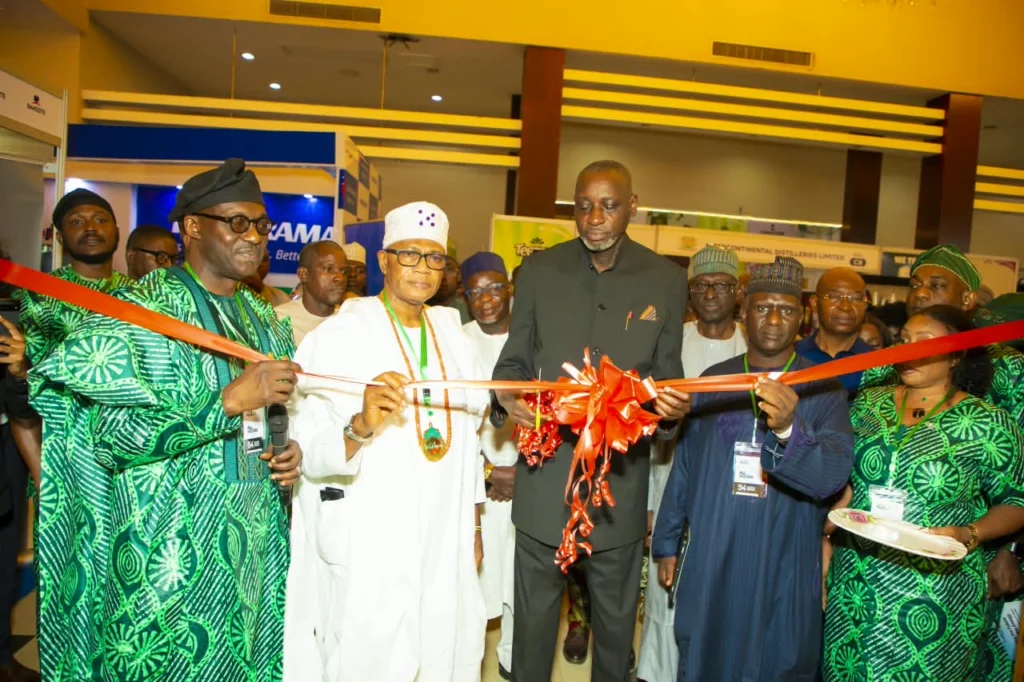
The President of MAN, Mr Francis Meshioye, made the call on Monday in Lagos at the opening of the three-day Made-in-Nigeria Exhibition.
The exhibition was held alongside the 54th Annual General Meeting of the association.
The event had the theme: “Leveraging National Industrial Policy to Position Nigeria as Africa’s Industrial Hub.”
Meshioye urged the Independent National Electoral Commission, political parties and government agencies to prioritise locally manufactured products during electioneering activities.
According to him, the forthcoming national, state and local government elections provide an opportunity to demonstrate patronage of made-in-Nigeria products.
“This national imperative must be adhered to by INEC, the different political parties and other government agencies connected with the exercise.
“All should give priority to the patronage of made-in-Nigeria items at this electioneering period and at all times and in all cases,” he said.
Meshioye described Executive Orders 003 and 005, and the Federal Government’s Nigeria First Policy as efforts to promote domestic production and patronage.
He urged President Bola Tinubu to facilitate the fast-tracking of the implementation of the orders and policies.
“It is time for action. The government should ensure strict compliance with the order.
“Ministries, Departments and Agencies of Government that fail to comply with the Executive Order should be sanctioned accordingly,” he said.
The MAN president said the association had sustained the Made-in-Nigeria Exhibition for eight years as part of its campaign to promote locally manufactured products.
He said the exhibition demonstrated the capacity of Nigerian manufacturers to produce high-quality, competitive and diverse goods in spite of the difficult macroeconomic environment.
Meshioye said increased patronage was critical to enabling manufacturers to scale production, increase capacity utilisation, create jobs and contribute more to government revenue.
He said positioning Nigeria as Africa’s industrial hub required more than increased domestic production.
He stressed the need for an operating environment that would enable manufacturers to produce competitively.
He identified energy costs, access to finance, industrial inputs, logistics, regulatory predictability and productivity as factors affecting manufacturers’ competitiveness and investment capacity.
According to him, Nigeria must move beyond consuming imported products and strengthen its capacity to produce what it consumes.
He said MAN would continue to engage government and regulatory institutions on reforms capable of supporting productive investment and improving manufacturing competitiveness.
Prof. Ayo Omotayo, Director-General, National Institute for Policy and Strategic Studies (NIPSS), said manufacturing must perform substantially better for Nigeria to achieve its ambition of becoming a one trillion dollar economy.
Omotayo said countries such as India, China and South Korea had demonstrated the importance of a strong manufacturing sector to economic development.
He said Nigeria’s large population made it economically unsustainable to depend heavily on imports, particularly when the country lacked sufficient foreign exchange to finance them.
“Going forward, it is not policy that will make manufacturing work. Policy has its own role, but eventually, it is how we approach the implementation of the policies.
“It is how we try to ensure that the provisions of the policies are used for the benefit of manufacturing that will make the difference,” he said.
Omotayo said the new national industrial policy, developed through collaboration among relevant stakeholders, could only deliver results through effective implementation.
He said manufacturing was capable of contributing far more to Nigeria’s Gross Domestic Product than its current level.
The NIPSS director-general said government and the private sector also needed to address the high cost of energy.
He described energy costs as a major challenge to manufacturing competitiveness.
He said NIPSS was proposing measures to the Federal Government to address power and energy challenges and ensure reliable and affordable electricity for manufacturers.
Omotayo also challenged MAN to work with the government and other stakeholders to develop a dedicated policy framework for raw materials.
He said Nigeria could not achieve sustainable industrialisation while spending trillions of naira importing production inputs.
He lauded MAN’s efforts to expose young Nigerians to manufacturing through the exhibition and encouraged them to patronise locally produced goods.
According to him, promoting local consumption among young people would help build a sustainable market for Nigerian products.
Omotayo also suggested establishing manufacturing clubs in universities to expose students to industrial processes and encourage innovation and collaboration between academia and industry.
Mr Segun Ajayi-Kadir, Director-General, MAN, said the association had begun engaging universities through a Memorandum of Understanding to strengthen academia-industry collaboration.
Ajayi-Kadir said the initiative would also serve as a yardstick for measuring the effectiveness of public-private partnerships in driving industrial development.
He said Nigeria’s industrialisation depended on the ability of the younger generation to understand, support and contribute to manufacturing.
The MAN director-general also highlighted the need to address key constraints facing manufacturers.
According to him, energy availability and affordability, production input costs, logistics and the regulatory environment remained major impediments to industrial competitiveness and investment.
“Addressing these challenges requires sustained policy action and effective collaboration between the government and the private sector.
“Nations can only industrialise by consistent and conscientious implementation,” he said. (NAN)
Edited by Chinyere Joel-Nwokeoma



Comments