


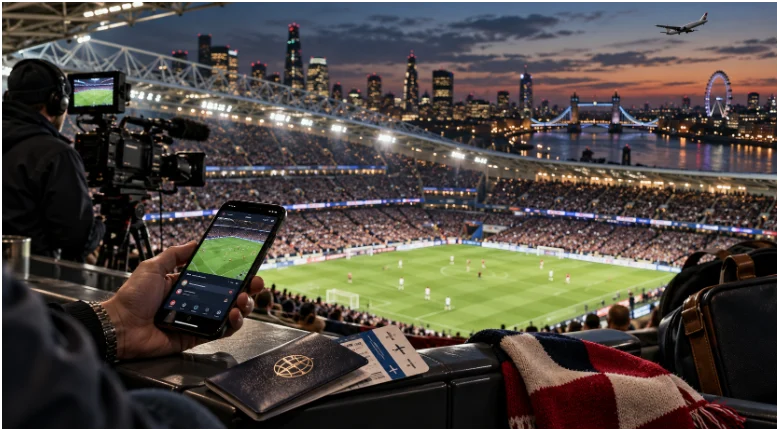
English football did not become a global business simply because the matches improved. The decisive turn came in 1992, when 22 First Division clubs resigned from the Football League and the new Premier League was formed with commercial independence over broadcasting and sponsorship. The first season kicked off on August 15, 1992, and BSkyB held the original live television deal. By 2026, EY estimated 1.9 billion followers worldwide, with Premier League broadcasts reaching 189 countries.
The Breakaway Made Television the Engine
The Premier League’s biggest commercial decision came before a ball was kicked in 1992: television rights would be sold as one league-wide package, not club by club. That gave broadcasters a single product to buy and, over time, turned the weekly fixture list into one of British sport’s most valuable exports. The current UK deal runs for four seasons, from 2025-26 to 2028-29, and is valued at £6.7 billion. Sky Sports and TNT Sports carry the live games, while the BBC keeps the highlights package. Overseas, the Premier League sells rights territory by territory rather than through one worldwide contract. Clubs still go to market together, though, so a broadcaster is buying access to a 380-match Premier League season, not sitting down with 20 clubs one by one.
Africa Is Part of the Rights Map
For the 2025-26 and 2027-28 cycles, SuperSport holds Premier League rights across Sub-Saharan Africa, while beIN Sports covers the Middle East and North Africa. For viewers in Nigeria, the competition therefore sits inside a regional rights package rather than a collection of one-off broadcasts. EY’s 2026 study valued Premier League broadcast export revenue at £1.8 billion, nearly matching the rest of the UK television sector combined. Few British entertainment products travel at that scale.
The Phone Became Another Stadium Entrance
The match is only one part of the audience now. The Premier League’s five-year Microsoft partnership, announced in 2025, powers a Companion drawing on more than 30 seasons of statistics, 300,000 articles and 9,000 videos, while the Archive reached its full launch in March 2026 with highlights and full-match replays from 1992-93 through 2024-25. For users looking to download the Airplane game (Arabic: تنزيل لعبة الطيارة), MelBet’s current guide also places Spribe’s Aviator inside its mobile app, where short rounds revolve around a rising multiplier and a player-selected cash-out point. The official guide states that the endpoint is random and determined using Provably Fair technology and an RNG.
Pre-Season Became a Ticketed Export
By late July, an English club’s preseason can look almost as much like a touring event as a training block. The 2025 Premier League Summer Series sent Bournemouth, Everton, Manchester United and West Ham across New Jersey, Chicago and Atlanta for six matches, bringing four familiar English badges into three US markets in little more than a week. The league already knew there was an audience for it: the 2023 edition drew more than 265,000 spectators across the tournament. In 2025, each venue ran as a double-header, so one ticket covered two Premier League games on the same day. That is a long way from the old model of a quiet friendly before the season starts; preseason itself is now something the league can package, sell, and take abroad.
The Offer Sits Where the Fan Already Is
By the time a supporter checks a lineup, an injury update, or the evening odds, most of that activity is already happening inside one account on one phone. On MelBet, a MelBet Egypt promo code (Arabic: برومو كود Melbet مصر) can be added at registration or later from the promotions section, depending on the offer. The details are spelled out campaign by campaign: who qualifies, how long the offer runs, and what wagering terms apply. There is no separate product to learn, just another layer inside the same sportsbook or casino account.
The Global Game Still Pays the Bills at Home
The Premier League may sell itself around the world, but a large share of that money ends up back in England. Deloitte put club revenue at £6.8 billion for 2024-25, up 8% on the previous season, with commercial income reaching £2.4 billion and matchday revenue topping £1 billion for the first time. EY gives the wider effect an even bigger number: between 2025 and 2028, the league is expected to generate £33 billion in UK gross value added and support 107,600 full-time-equivalent jobs each year. The overseas audience also shows up physically; in 2023-24, around 1.1 million international visits to the UK were linked to Premier League football.