


By Kennedy Sheyin
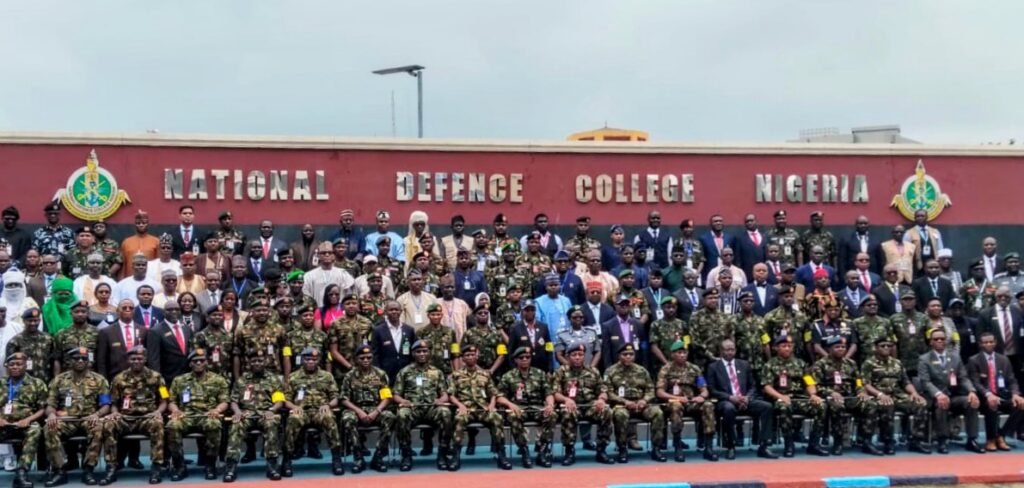
The National Defence College, Nigeria on Monday hosted a landmark two-day international conference on Restorative Justice for Victims of Violent Extremism.
The conference, themed “Restorative Justice and Management of Victims of Violent Extremism in Africa”, took place at the NDC premises in Abuja.
The conference is organised in collaboration with the Centre for African Peace and Conflict Resolution, California State University, Sacramento, USA, and the Ambassador Bulus Lolo Centre for Diplomacy, Conflict, Peace and Plural Studies, Bingham University, Nigeria.
The Commandant of the NDC, Rear Adm. Abdullahi Ahmed said that the conference could not have come at a more appropriate time.
“Across Africa violent extremism, insurgency and communal conflicts have left deep physical, psychological and social scars on individuals and communities.
“While security operations remain indispensable in confronting these threats, sustainable peace demands much more than military success. It requires healing, justice, reconciliation, community resilience and the restoration of human dignity.
“These are the ideals that define restorative justice and make this conference both timely and strategically important,” he said
According to the commandant, the NDC recognises that security challenges are increasingly complex and interconnected.
He said that as Nigeria’s premier institution for strategic military education, NDC remained committed to developing leaders capable of integrating security, governance, justice and development into comprehensive responses to contemporary threats.
“It is therefore gratifying that this conference brings together distinguished scholars, policymakers, security practitioners, judicial officers, humanitarian actors, development partners and the 2026 Africa Peace Fellows,” he said.
He noted that the gathering aimed to collectively examine practical pathways for managing victims of violent extremism and strengthening peace building across the African continent.
“I am particularly delighted that the programme combines high-level policy dialogue, expert presentations, interactive discussions, practical workshops and cross-country learning experiences.
“I am confident that these engagements will generate innovative ideas, strengthen professional networks and produce actionable recommendations that participants will adapt within their respective institutions and countries”, he said.
He appreciated the collaborators, noting that the partnership demonstrated the power of international collaboration in building the next generation of African peace leaders and advancing sustainable peace on the continent.
He also encouraged the participants to engage openly, learn from each other, challenge conventional thinking and build lasting professional relationships.
“The future of Africa’s peace and security depends on visionary leadership, innovative ideas and our collective determination to transform conflict into opportunities for reconciliation, recovery and lasting stability,” he added.
Also speaking at the conference, Prof. Adam Ahmed, the Provost, Center for Strategic Research and Studies, NDC, said that there were crises in Nigeria, in Africa and the world at large, noting that with crises, comes victims.
“In Nigeria, we have our own section of the crisis, the Boko Haram, the ISWAP, the various raids, and others across the country are well known to the world, not only to Nigeria alone.
“There have been several victims, and the government and armed forces are doing a lot to reassure, and restore hope to the victims of this unfortunate, obnoxious crisis,” he said.
He added that the various governments in the Sahel, West Africa, and all parts of Africa where crisis had become so endemic and devastating had also been making a lot of effort to reassure the victims.
“So this conference, like the theme suggests, is to bring out a discourse on the subject, to interrogate the various components of the crisis and to come out with a policy resolution that can guide the various governments in Africa on how to handle the victims.
“We have participants from 19 African countries, and with our collaborator, the California State University at Sacramento and the University of Bingham,” he said.
He said that at the end of the conference, there would be a workshop where resolution reached would come out in the form of policy, and a brief that would be sent to the various governments across Africa.(NAN)
Edited by Deborah Coker

Comments