


By Mustapha Yauri
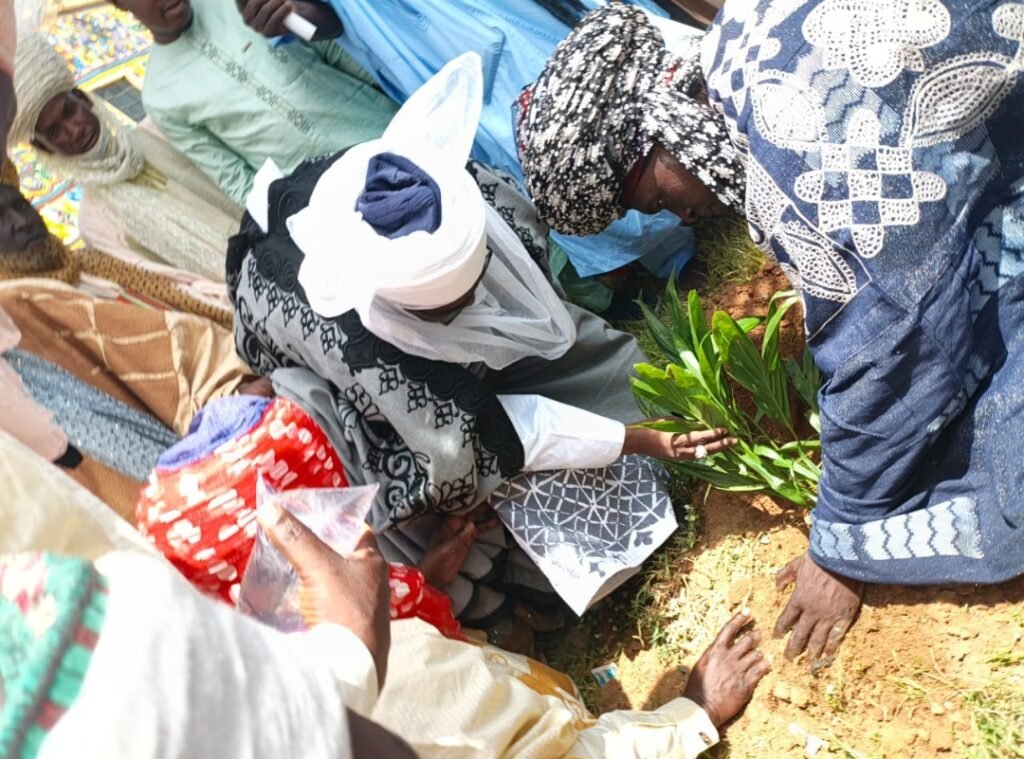
The Emir of Zazzau, Malam Ahmed Bamalli, has inaugurated a major tree-planting exercise along sections of Zaria’s ancient city walls, representing a historic blend of cultural preservation, environmental sustainability and ecological action.
The event, which took place on Monday, marked the completion of the Women Empowerment and Climate Resilience Initiative (WECRI), an impactful environmental project executed by the civil society group, Bridge That Gap Hope for Africa Initiative (BTG).
Supported by the Partnership for Agile Governance and Climate Engagement (PACE), BTG has successfully planted 6,000 trees under the WECRI project, 2000 each in Chikun, Zangon Kataf and Zaria Local Government Areas of Kaduna State.
Bamalli planted the first tree along the iconic city walls, an ancient structure famously associated with the legendary 16th-century warrior, Queen Amina.
Addressing guests and community leaders at the palace, the royal father expressed deep appreciation to the BTG team for their steadfast commitment to the welfare of the Zazzau Emirate.
“Thank you very much for finding time to come again and to support the Emirate through tree planting. This is remarkable and will help address the issue of soil degradation in our environment.
Emphasising the urgent need for land reclamation efforts, Bamalli further highlighted the strategic timing of the exercise, noting that the ongoing rainy season provides optimal soil moisture for the saplings to root effectively and thrive.
“We are grateful to you and equally happy that you have come during this period, the rainy season,” he added.
Demonstrating unified leadership, key members of the Zazzau Traditional Council joined the Emir, including the District Head of “Birni da Kewaye”, Alhaji Sambo Idris, who also planted a tree.
After the inauguration, BTG team and community volunteers distributed the remaining seedlings to pre-selected planting sites spanning various vulnerable zones across Zaria.
In his remarks, BTG Programme Officer, Mr Zinta Akpoko, explained that the goal of the project was to promote environmental sustainability.
He added that the project was also designed to contribute to the protection and restoration of sections of the centuries-old city walls that have been affected by erosion and encroachment.
He said that by establishing living green barriers along the historic ramparts, the initiative directly targets long-term environmental sustainability while safeguarding one of Northern Nigeria’s most cherished historical landmarks.
He noted that over the years, vast sections of the centuries-old mud walls have suffered severe degradation, driven primarily by unchecked soil erosion and human encroachment.
“The tree-planting exercise represents not only an environmental intervention but also a step towards preserving Zaria’s historical heritage while promoting community participation in climate resilience.
“As the trees mature into deep-rooted trees, they are expected to provide additional vegetation cover around the historic structure.
“Beyond their ecological function, the growing trees will serve as permanent, living markers delineating and honouring Zaria’s rich cultural heritage for future generations,” he said.
Noting the power of traditional authority in climate action, Apkoko described the Emir’s direct involvement as “a crucial catalyst for long-term project sustainability”.
“We could not ask for a stronger endorsement than the Emir planting the first tree himself and charging residents to protect it.
“Trees survive when communities own them — and in Zaria, the palace has just made that ownership official,” he added.
The programme officer said that tree planting exercise marked the completion of WECRI, a project designed to strengthen community resilience through locally led climate adaptation and environmental sustainability initiatives.
He added that the project included capacity-building workshops for grassroots women across Kaduna State, aimed at strengthening their knowledge and capacity to respond to climate-related challenges.
“For BTG, successfully wrapping up the initiative in Zaria demonstrates how powerful synergies between traditional institutions, civil society, and local communities can effectively combat pressing environmental challenges,” he said.
The News Agency of Nigeria (NAN) reports that BTG had earlier decorated the Emir of Zazzau as a “Climate Ambassador” in recognition of his unwavering advocacy for grassroots environmental solutions. (NAN)
AM/FDY
=======
Edited by Philip Yatai

Comments