


By Lucy Ogalue
The Bureau of Public Procurement (BPP) says government agencies must not procure vehicles from suppliers and manufacturers not registered by the National Automotive Design and Development Council (NADDC).
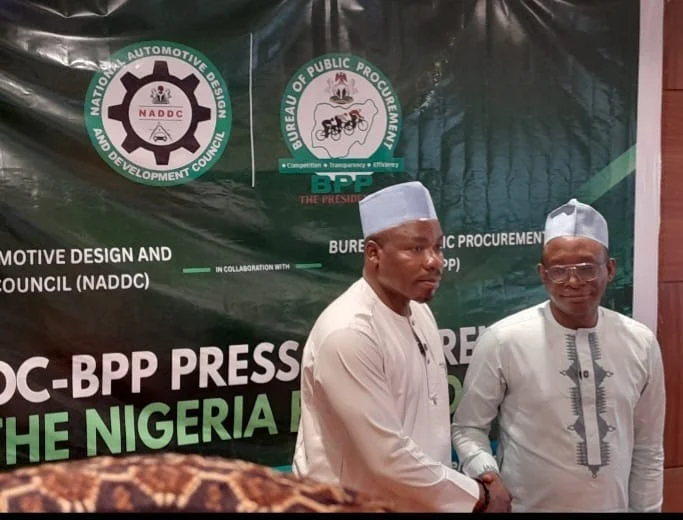
The Director-General of BPP, Dr Adebowale Adedokun, said this at a joint news conference organised by the BPP and the National Automotive Design and Development Council (NADDC) on Friday in Abuja.
He gave the warning while explaining measures to enforce the Federal Government’s Nigeria First policy.
“BPP will not give a no objection to any government agency that wants to buy a vehicle from any supplier, manufacturer or importer that has not passed through the specification and requirement of NADDC.
“If they do, it is a criminal offence. It is subject to prosecution,” Adedokun said.
He said NADDC was responsible for registering vehicle manufacturers and maintaining an updated database of approved suppliers, while BPP ensured compliance with procurement requirements.
Adedokun said the policy encouraged partnerships between local firms and foreign manufacturers to strengthen domestic production capacity and promote technology transfer.
“So, what we are doing now is to say partner with the local firm and the foreign to build your own capacity,” he said.
He added that the Public Procurement Act 2007 provided preferential treatment for locally manufactured products, even where there prices were slightly higher than imported alternatives.
“The law is saying even if the cost of the locally made, manufactured, is slightly higher than the one that is coming from abroad, we will still give it to the local man,” he said.
According to him, the preference will support employment, factory expansion and increased production, helping to offset initial price differences.
The BPP chief said the Bank of Industry would also support the automotive sector with financing at lower interest rates.
He said a joint monitoring and evaluation committee had been established to track vehicle procurement by government agencies and identify possible violations.
Adedokun said the Federal Executive Council had directed government agencies to submit monthly and quarterly reports on their procurement activities to BPP.
He added that the Economic and Financial Crimes Commission and the Independent Corrupt Practices and Other Related Offences Commission were requesting procurement records to monitor compliance.
The Director-General of NADDC, Mr Joseph Osanipin, said Nigeria had sufficient capacity to increase local vehicle production and reduce dependence on imported vehicles.
On the country’s current level of local vehicle production, Odanipin said “We are doing about less than eight per cent of what we are using in Nigeria.”
He said the council aimed to increase local production progressively, with a target of meeting 70 per cent of Nigeria’s vehicle requirements.
“Can we take that eight per cent to 20, to 40, and then to 70? If we can achieve 70 per cent, we have done well,” he said.
Osanipin explained that increased production volumes would help reduce prices by allowing manufacturers to spread costs across more vehicles.
“Because by the time the volume increases, the price is going to drop. Because the assemblers want to sell more of those vehicles,” he said.
He also disclosed that NADDC was collaborating with universities, polytechnics and technical institutions to commercialise locally developed automotive technologies.
Osanipin said 12 universities had designed buses under the council’s Campus Shuttle programme, while an electric tricycle developed at its Zaria office had attracted interest from potential buyers.
He added that one prospective buyer had indicated willingness to purchase about 300 electric vehicles, while the council continued engaging local assemblers to support production.(NAN)(www.nannews)
Edited by Francis Onyeukwu
Comments