


By Angela Atabo
The Minister of Water Resources and Sanitation, Prof. Joseph Utsev, has charged water engineers to drive innovation, strengthen governance and ensure sustainable management of Nigeria’s water resources.
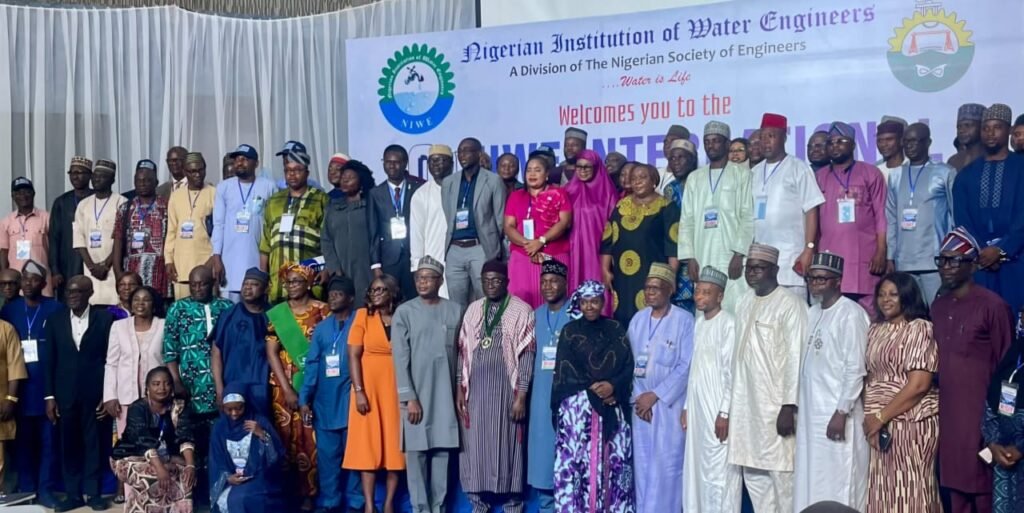
Utsev gave the charge on Tuesday in Abuja at the 9th International Water Conference of the Nigerian Institution of Water Engineers (NIWE).
The conference has the theme: “Effective Water Governance and Security: Innovating for a Resilient Future.”
The minister, represented by Mr Ali Dallah, Director, Dams and Reservoir Operations, said water was fundamental to life and economic development.
He, however, noted that the sector faced challenges from climate change, rapid urbanisation, inadequate infrastructure and transboundary water management.
“This is where innovation, technology and professional expertise become indispensable. The engineering profession, and NIWE in particular, has a critical role to play.
“We need to harness digital technologies, remote sensing, artificial intelligence, real-time monitoring systems, modern hydrological and hydrogeological tools and improve data management systems to transform the way we plan, develop and manage water resources.
“We must also encourage stronger collaboration between government, professional institutions, academia, the private sector, development partners and local communities.
“No single institution can address the water challenges of a nation as large and diverse as Nigeria. As engineers, we must therefore move from simply identifying challenges to developing practical, scalable and sustainable solutions”.
Utsev urged participants to deliberate on innovative financing mechanisms, public-private partnerships, climate-resilient infrastructure, digital water management, dam safety, irrigation development, sanitation and capacity building for policy development.
Also speaking, the President of the Nigerian Society of Engineers (NSE), Ali Rabiu, commended NIWE for advancing knowledge, innovation and professional excellence in water engineering.
Rabiu said effective water governance required strong institutions, evidence-based policies, integrated planning, responsible resource management, technology adoption and collaboration among stakeholders.
“Engineers have always been at the forefront of solving society’s most complex challenges. From the design of dams, water treatment plants and irrigation systems to the development of urban drainage networks and climate-resilient infrastructure.
“The engineering profession remains central to achieving water security. However, the challenges before us require a stronger partnership between engineers, government institutions, academia, private sector organisations and international development agencies.
“We must promote integrated water resources management that considers the interconnected relationship between water, energy, agriculture, environment and human development.”
The keynote speaker, Dr Abdulmumuni Aminu-Zaria, Executive Director, Nigeria Integrated Water Resources Management Commission (NIWRMC), said recurrent water challenges and climate effects reflected weaknesses in managing the nation’s water resources.
Aminu-Zaria, represented by Sakinatu Jimeta, Director, Catchment Management and Water Utilisation, said water security would not be achieved through infrastructure alone.
He said sound engineering must be complemented by institutional mandates, transparent allocation rules, data and political will.
“We need innovative financing models, blended public-private investments, water infrastructure bonds, climate adaptation funds to close Nigeria’s water infrastructure gap, which, by conservative estimates, runs into billions of dollars.
“We need innovative regulatory instruments, including tiered licensing fees and enforceable water use permits that create the right incentives for conservation and efficient use.
“We need innovation in how we build capacity, training the next generation of Nigerian water engineers, hydrologists and policy analysts who can operate at the intersection of engineering rigour and governance sophistication.
“This is precisely why gatherings such as this one matter. NIWE brings together the technical expertise that makes resilient water infrastructure possible.”
In his remarks, the National Chairman of NIWE, Joshua Sanga, said the conference was organised to highlight challenges facing Nigeria’s water sector and chart the way forward.
Sanga said effective governance, sound policies, competent professionals, appropriate technology, sustainable investment and collaboration were needed to build a resilient water sector.
“Nigeria’s water sector faces complex challenges, including inadequate access to safe water, sanitation deficits, flooding, drought, groundwater depletion, climate variability, ageing infrastructure and increasing pressure on our water resources.
“These challenges require innovative and resilient solutions, supported by effective water governance and strong professional leadership.
“As water engineers, we have a critical role to play. Our responsibility goes beyond designing and constructing infrastructure; we must contribute to the planning, management, protection and sustainable utilisation of our water resources.”
The NIWE chairman expressed confidence that continued collaboration among government, professional bodies, academia, and other stakeholders would strengthen Nigeria’s water security and contribute to sustainable national development. (NAN) www.nannews.ng
Edited by Tosin Kolade

Comments