


By Esther Nwabueze and Mercy Omoike
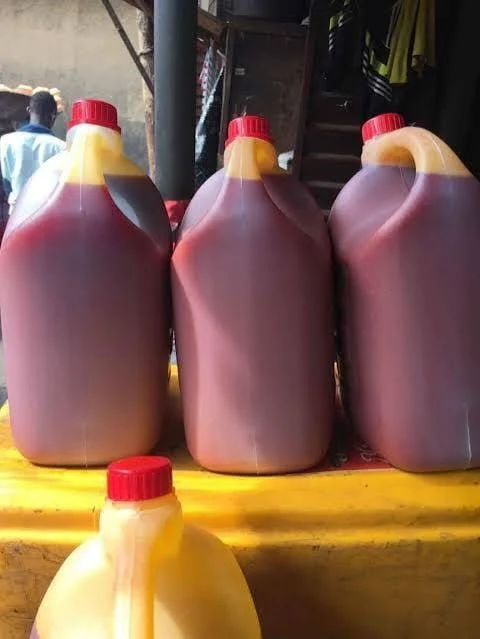
Some Lagos consumers and traders are increasingly relying on taste, colour and aroma to detect suspected adulteration of palm oil.
They shared their experiences in separate interviews with the News Agency of Nigeria (NAN) on Sunday in Lagos.
For some consumers, identifying genuine palm oil has become a matter of careful observation before buying or using the product.
NAN reports that concerns over palm oil quality have drawn attention to how the product is processed and stored before reaching consumers.
Some consumers have also raised concerns that palm oil may be mixed with colouring substances to improve its appearance.
Mrs Chidinma Nwabueze, a palm oil trader at Oyingbo Market, said she sourced her products mainly from trusted factories and major suppliers.
Nwabueze said she sometimes bought palm oil from suppliers in the eastern part of the country and others who transported it to Lagos.
She said familiarity with the product was important in detecting suspected adulteration, as some mixed oils could appear similar to genuine palm oil.
Nwabueze said consumers unfamiliar with palm oil might not detect adulteration until they used the product for cooking.
“Someone who is very familiar with palm oil will be able to differentiate the original and the mixed one through its colour, thickness and smell.
“If you are not familiar with palm oil, you may not know until you prepare your food.
“When you buy genuine palm oil, a small quantity is enough to give your food the desired reddish colour.
“But if you buy the one that has been mixed with colour, you will keep pouring and pouring without getting the consistency and the colour you want,” she said.
Ms Goodness Okoro, a resident of Apapa Road, said her suspicion about the quality of some palm oil arose from her experience while preparing soup.
Okoro said she used more than the usual quantity of oil, but it failed to produce the expected colour and consistency.
“I look out for the taste and colour to ensure good quality. I am very much concerned about the health implications of adulterated palm oil.
“I wouldn’t mind paying more if I can get the quality I want that can ensure and give me good food taste,” she said.
Mummy Joy, a resident of Ikotun, said she had heard about the practice of mixing palm oil with other substances but did not know the specific substances involved.
She said she sourced her palm oil directly from the eastern part of the country and relied on its appearance and taste to identify genuine products.
“You can identify fake palm oil by tasting it; when you taste it you will know,” she said.
Mr Okoro Ebube, a resident of Ibadan Street in the Costain area, said he was concerned about the prevalence of suspected adulterated palm oil.
Ebube alleged that some suppliers mixed palm oil with colouring substances, making it difficult for consumers to distinguish the products.
He said genuine Nigerian palm oil was naturally red and could retain its colour longer than some products mixed with colouring substances.
“Palm oil from the village is naturally pure red without mixing anything, and it can last longer than the one they mix with colouring substances.
“My own palm oil comes from my village, and the one they bring to me here in Lagos can stay for more than one year and still remain good,” he said.
Ebube urged relevant authorities to investigate the issue, saying suspected adulterated palm oil had become difficult for ordinary consumers to identify.
He said colouring substances could make suspected adulterated products appear similar to genuine palm oil.
“I can identify it through the taste, the sediment and the colour. For the mixed one, when you check the bottom, it can form a block.
“While the original one will have sediment without changing colour. Those are the three ways I use to identify it,” Ebube said.
He urged those involved in mixing palm oil with colouring substances to desist from the practice, expressing concern over possible health implications.
NAN reports that the Lagos State Consumer Protection Agency has also raised concerns over the increasing sophistication of palm oil adulteration.
The agency urged consumers to remain vigilant when purchasing palm oil.
The warning followed a technical presentation at the Lagos State Food Safety Conference and Exhibition 2026.(NAN)
DMO/JNC
========
Edited by Chinyere Joel-Nwokeoma



Comments