









By Lucy Ogalue, News Agency of Nigeria (NAN)
For decades, Nigeria dreamed of becoming a major automotive manufacturing hub in Africa.
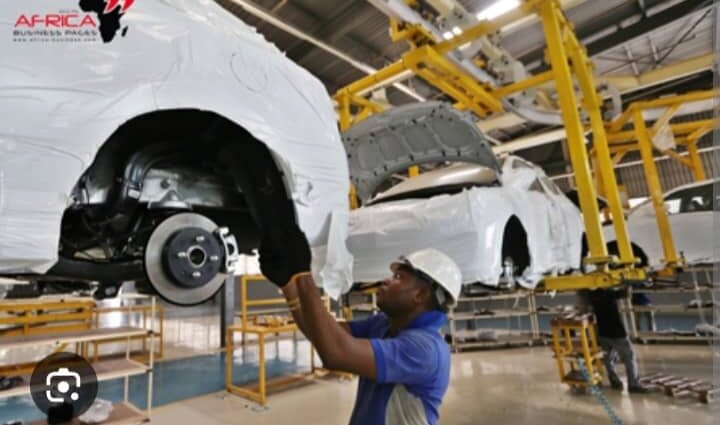
Assembly plants sprang up across the country, creating expectations that vehicle production would generate jobs, transfer technology and gradually reduce dependence on imported automobiles.
Volkswagen operated in Lagos, Leyland in Ibadan, Mitsubishi in Ilorin and ANAMMCO in Enugu, among other plants.
But the dream gradually lost momentum.
Production declined, factories became dormant or changed ownership, local component manufacturing remained weak, while imported vehicles, particularly used cars, took over much of the market.
Today, the Federal Government is again pushing to revive the industry.
But experts say Nigeria must first understand why the earlier model failed, or risk repeating the same mistakes.
Mr Chris Oputa, Director-General, National Association of Small Scale Industrialists (NASSI), offers a unique interpretation of Nigeria’s automotive crisis, arguing that the automotive industry itself had not collapsed.
“Rather, the major problem is the decline of the new-vehicle market, particularly locally manufactured and brand-new imported vehicles.
“The industry as a whole is thriving, but the manufacturing and brand-new cars generally are not selling at the pace at which they should.’’
According to him, the biggest factor is the dramatic fall in Nigerians’ purchasing power following the depreciation of the naira.
He recalled that in 2014, a brand-new Kia Rio could be bought for a few million naira, whereas similar vehicles now cost tens of millions.
“People’s earnings did not change commensurate with the lost value of the currency.
“Consequently, many Nigerians have turned to used vehicles because they are considerably cheaper than new cars,” he said.
Oputa believes that restoring the new-car market requires more than simply establishing assembly plants.
According to him, Nigeria must also address the exchange-rate pressures and economic conditions that make locally assembled vehicles unaffordable to ordinary consumers.
But the problem goes deeper as Prof. Samuel Odewumi, a transport and environment expert who once worked at the Leyland Motor Assembly Plant, agrees that the industry faces serious structural problems.
Unlike Oputa, he traces the problem to the way Nigeria approached automotive manufacturing from the beginning.
According to him, Nigeria never sufficiently developed the progressive manufacturing system originally envisaged for the industry.
“Initially, it was acceptable for plants to import completely knocked-down components and assemble them locally.
“However, as production matured, more components were expected to be manufactured in Nigeria and that transition never happened to the extent required.
“We did not get our methods right; we did not get our technology right, and we did not get our philosophy right.”
He explained that the industry remained excessively dependent on imported components, leaving it vulnerable to foreign-exchange shortages and economic shocks.
Odewumi warned that simply bringing vehicles into Nigeria in completely knocked-down form and assembling them locally did not create a deep manufacturing industry.
“If you are importing 100 per cent CKD, that company will just find out that wholesale importation will not work.
“We need progressive localisation, beginning with components that Nigeria can realistically produce; Tyres, batteries, wiring, lights, upholstery and other components, should increasingly be produced domestically.
“What we need to import should be the chassis and the engine,” he said.
According to him, such an approach will create opportunities for hundreds of Nigerian companies beyond the assembly plants themselves.
He said it would also generate jobs in steel, plastics, electrical components, textiles, engineering, logistics and other supporting industries.
Meanwhile, the Federal Government has expressed its determination to address these weaknesses.
Minister of State for Industry, Sen. John Enoh, has repeatedly stressed the importance of local manufacturing, skills development and an enabling environment for the automotive sector.
According to Enoh, the Federal Government introduced the Nigeria First Policy, under which public institutions are encouraged to prioritise locally produced goods, including vehicles.
Minister of Industry, Trade and Investment, Dr Jumoke Oduwole, similarly identified automotive manufacturing as an important part of Nigeria’s industrial development.
Oduwole said the Federal Government was reviewing the country’s automotive policy to accommodate emerging technologies and align the sector with global trends in sustainable mobility and industrial development.
She has also promoted greater patronage of locally assembled vehicles under the Nigeria First Policy, describing locally assembled automobiles as capable of demonstrating Nigerian manufacturing capacity.
The policy direction is significant because Nigeria’s previous automotive experience was undermined partly by inconsistent policies and inadequate development of local supply chains.
For the National Automotive Design and Development Council (NADDC), the revival must go beyond assembly.
The NADDC Director-General, Joseph Osanipin, has advocated stronger local production of automotive components, including tyres and batteries, while encouraging technology transfer and investment in the wider automotive value chain.
He said the NADDC had also pushed for legislative backing for the National Automotive Industry Development Plan, arguing that investors required policy certainty before committing substantial long-term capital.
“This is important because automotive manufacturing requires huge investments that cannot be recovered quickly.
“An investor establishing an assembly plant needs confidence that tariffs, local-content requirements, import rules and incentives will remain reasonably predictable,” he said.
However, even the best industrial policy will struggle if Nigerians could not afford the vehicles being produced. And this is where Oputa’s argument becomes particularly important.
Oputa believes car loans alone would not solve the problem because high interest rates could make monthly repayments unaffordable.
“If the car is N30 million and you give someone a five-year loan, how many people earn enough to pay N600, 000 every month?”
For him, Nigeria’s automotive revival must therefore be accompanied by broader economic recovery, stronger purchasing power and a more stable naira.
“The industry needs customers who can afford locally produced vehicles,” he said.
On his part however, Odewumi, believes affordability must be tackled alongside industrial capacity.
He warned that Nigeria could not build a sustainable automotive sector by simply importing components, assembling them and calling the result local manufacturing.
“The industry must develop what I described as ‘roots’ within the Nigerian economy.
“For me, those roots are local suppliers, technical expertise, technology, financing and a dependable market,” he said.
Mr Chukwuma Madueke, an economic expert, reiterated that local producers had continued to grapple with high production cost.
“We need stronger incentives and deliberate enforcement of auto policies to grow local content. Without strong local content and reliable infrastructure, our growth will remain limited.
“By promoting local assembly, investing in component production and ensuring sustained government patronage, we can finally position this sector as a driver of industrial growth,’’ he said.
Similarly, Mr Anthony Attah, an automobile expert, said building a car in Nigeria costs far more than importing one.
“A locally assembled vehicle rolls off the line already more expensive than a foreign rival before a single customer walks in.
“Nigerian buyers, squeezed by inflation and a weak naira, long ago made their peace with “tokunbo” (fairly used imports) that often cost less than half the price of a new, locally assembled car,” he said.
It is worth noting that Nigeria’s transition towards compressed natural gas (CNG) and electric vehicles (EVs) also presents an opportunity to build a different automotive industry.
Nonetheless, experts warn that Nigeria must avoid becoming merely an assembly destination for imported electric vehicles and CNG components.
Nigeria’s car industry faces two hurdles: building real local manufacturing instead of relying on imports, and boosting citizen purchasing power.
While government policies are a start, long-term success depends on learning from past mistakes and going beyond just restarting assembly line.
In all these, Innoson Vehicle Manufacturing (IVM) is bringing some glimmer of hope.
Founded by Innocent Chukwuma in 2007 and based in Nnewi, Anambra State, IVM designs durable, affordable vehicles tailored for local terrain.
The company also exports to neighboring West African countries and drives local industrialisation and job creation.
It supplies commercial buses, SUVs, and utility vehicles to several West African nations—Ghana, Mali, Sierra Leone, among others.
Going forward, stakeholders say there is a need for a robust industrial base, an affordable market, robust local supply chains, and policy stability capable of keeping the manufacturing and assembly lines running for generations.(NANFeatures)