


By Eniola Elewude
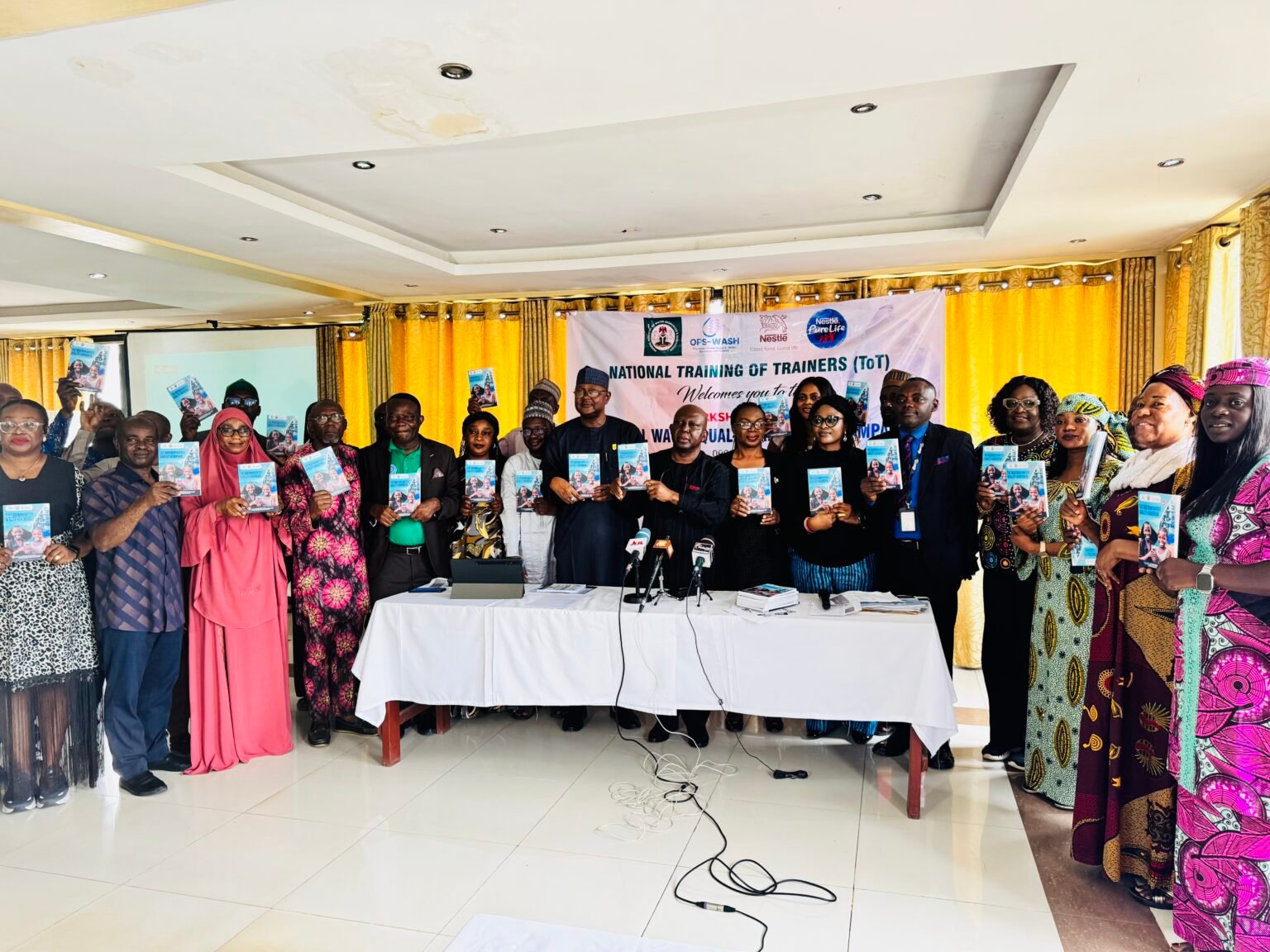
The Federal Government, Nestlé Nigeria Plc and the Organised Private Sector in Water, Sanitation and Hygiene (OPSWASH) have pledged stronger collaboration to improve water quality and protect Nigerians from water-related diseases.
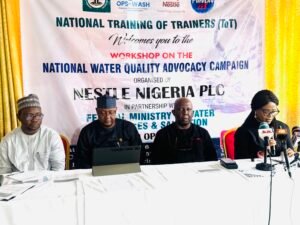
Dr Nicholas Igwe, Global Coordinator, OPSWASH, made the pledge on Thursday at a Training of Trainers workshop on the Water Quality Handbook in Abuja.
Igwe said the partnership with the government would take water quality advocacy beyond project sites to communities across the country.
He said the private sector had a responsibility to complement government efforts by equipping communities with the knowledge and tools to understand and protect water quality.
Igwe said the Water Quality Handbook, launched on April 1 with the support of the Federal Ministry of Water Resources and Sanitation, was developed to improve public understanding of water quality.
He said the handbook would help communities understand the physical, chemical and biological parameters of water, their health implications and the economic consequences of consuming unsafe water.
“The handbook is intended to reach communities directly, enabling people to understand the quality of the water they consume, its health implications and broader economic impact,” he said.
Igwe said the Training of Trainers programme would create a network of master trainers to cascade the knowledge to states, local government areas and communities.
He said the initiative would also strengthen collaboration with state governments to ensure trainers received the support needed to implement the campaign.
According to him, unsafe water could contribute to diarrhoeal diseases, typhoid and other water-related illnesses, with implications for productivity and economic development.
“Only healthy people can build a healthy economy. When communities are exposed to unsafe water, the consequences can include diarrhoeal diseases, typhoid and other water-related illnesses,” he said.
Igwe said the partnership was further demonstrated through Nestlé’s Water Regeneration Project, which focuses on water access, quality, governance and sustainable agricultural water management.
He said Nestlé had committed to providing 270,000 cubic litres of water annually to 16 communities in Abaji, FCT, and 130,000 cubic litres to eight communities in Agbara, Ogun.
He said the commitments corresponded to the volume of water bottled annually by Nestlé from the respective catchment areas.
Igwe said the project involved communities in its design, implementation and monitoring to promote ownership and sustainability.
He added that it supported water-harvesting systems for irrigation, contributing to sustainable agricultural production and food security.
Representing the Minister of Water Resources and Sanitation, Prof. Joseph Utsev, Mr Habu Jamilu, a director in the ministry, said the government was committed to partnerships that would improve water quality nationwide.
Jamilu said access to water without adequate attention to quality would not sufficiently protect Nigerians from waterborne diseases.
He said the ministry would continue working with OPSWASH, private-sector organisations, development partners and communities to strengthen water quality management and public awareness.
He said the Training of Trainers programme would build technical capacity and ensure water quality knowledge reached states and local government areas.
Jamilu said the training was particularly timely during the rainy season, when flooding could increase the risk of water-source contamination.
He urged participants to apply the knowledge gained to promote safe water management and reduce health risks associated with contaminated floodwater.
Engr. Nnena Igwegbe, representing the Association of Professional Women Engineers of Nigeria (APWEN), said water quality was fundamental to public health, food security and sustainable development.
Igwegbe said water quality was both an infrastructure and behavioural challenge requiring coordinated action by government, professionals, the private sector and communities.
She said APWEN remained committed to promoting women engineers’ involvement in addressing water, sanitation and environmental challenges through technical expertise, advocacy and community engagement.
Igwegbe urged the trainers to see their role as extending beyond technical knowledge transfer to empowering communities to adopt safer water-handling, storage and treatment practices.
She said stronger partnerships among government, professional bodies and the private sector would be critical to achieving sustainable access to safe water and building healthier, more resilient communities.
Mr Saidu Shuaibu, a representative of the Nigeria Hydrological Services Agency (NIHSA), said the training was timely given increased flood risks during the rainy season.
Shuaibu urged participants to apply the knowledge gained to protect communities from health risks associated with contaminated floodwater.
The News Agency of Nigeria (NAN) reports that OPSWASH is a global coordinating platform for private-sector participation in the WASH sector.
It works through three core pillars of corporate social responsibility and philanthropy, financial innovation, and technology and data.
Following the launch of the Water Quality Handbook at the 2026 Annual Water Quality Conference, the ministry has commenced its nationwide implementation under the National Water Quality Management Campaign.
The workshop aims to develop master trainers from relevant MDAs, development partners, academia and professional institutions.(NAN)
Edited by Tosin Kolade


Comments