







By Grace Abe
President Bola Tinubu has reaffirmed his administration’s commitment to ensuring that development is felt across Nigeria’s grassroots communities.
Tinubu made the commitment on Tuesday in Abuja at the National Conference of 774 Local Government Council Chairmen.
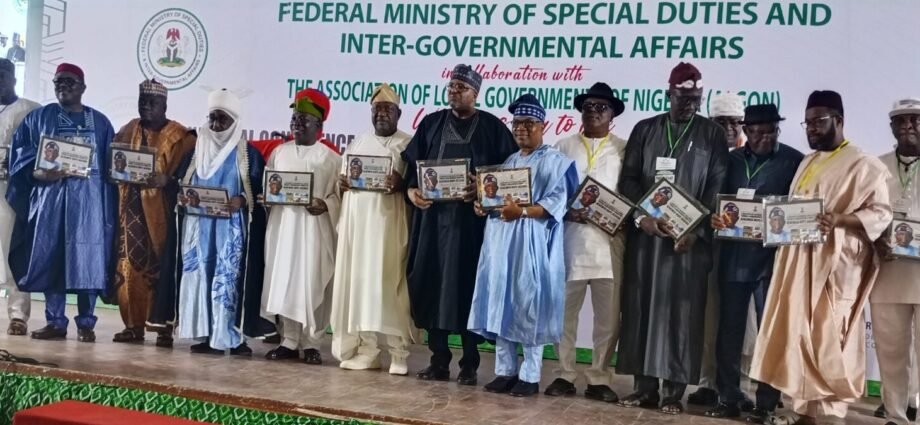
The conference was organised by the Federal Ministry of Special Duties and Inter-Governmental Affairs (FMSDIGA), in collaboration with the Association of Local Governments of Nigeria (ALGON).
Represented by the Secretary to the Government of the Federation, George Akume, Tinubu said the conference theme was timely.
The theme was: “Cascading President Bola Tinubu’s Renewed Hope Agenda to the Grassroots.”
He said the true test of government policy was not what was announced in Abuja, but the changes experienced in villages, towns and communities.
Tinubu said Nigeria’s rapidly growing population required government to move closer to the people through stronger grassroots development.
“Our vision and mission is shortening the distance between government and the government, widening access to services and creating more centres of local development,.
“Development must come from the bottom up,” Tinubu said
He said his administration, since 2023, had pursued national development based on the belief that Nigeria could not evolve from the centre alone.
The President also stressed the need for communities across the country to experience tangible improvements.
He said such improvements should include better primary healthcare, basic education, rural roads, safe water and stronger food systems.
The President also identified support for small businesses and opportunities for women and young people as important components of grassroots development.
Tinubu urged local government chairmen, councillors and management teams to use their autonomy to deliver impactful governance and measurable development.
He said the Supreme Court judgment affirming local government autonomy placed a huge responsibility on councils to provide effective services.
The President recalled that his administration had demonstrated political will by approaching the Supreme Court to affirm the constitutional rights and financial autonomy of local governments.
He described the July 11, 2024 judgment as historic, stressing that local government autonomy should serve as an instrument for development.
“Local Government autonomy is not an end in itself, rather, it is an instrument for service and development,” he said.
Tinubu urged councils to become centres of planning, service delivery, early warning and measurable results in their respective communities.
He also unveiled the conference compendium titled: “Snapshots of President Bola Ahmed Tinubu’s Achievements under his Renewed Hope Agenda.”
Earlier, the Minister of Special Duties and Inter-Governmental Affairs, Mr Zaphaniah Jisalo, said the Renewed Hope Agenda was focused on improving the lives of Nigerians.
Jisalo said its impact must be felt in communities, noting that local governments were closest to the people and had critical grassroots responsibilities.
He said local governments played important roles in translating national policies and programmes into sustainable development outcomes.
According to him, councils were also expected to strengthen intergovernmental relations, enhance accountability and ensure government programmes reached intended beneficiaries.
Jisalo said local governments were critical stakeholders in peace-building, community mobilisation and sustainable development across the country.
Also speaking, the ministry’s Permanent Secretary, Dr Onwusoro Maduka, presented a status report on the e-tracking of projects by local government councils.
Maduka said the e-tracking initiative had strengthened project visibility, monitoring and accountability at the grassroots.
He said the ministry planned to improve the framework for monitoring projects and implementing interventions across Nigeria’s 774 local government areas.
According to him, the framework would provide a structured mechanism for capturing and monitoring projects, including their locations, across the councils.
The Minister of State for Foreign Affairs, Shola Enikanolaiye, said domestic government policies had implications for Nigeria’s foreign policy and international relations.
Enikanolaiye said grassroots mobilisation and development were critical, noting that foreign policy was also a projection of domestic policies.
His Royal Highness Felix Mujakperuo, Orodje of Okpe in Delta, represented traditional rulers at the conference and commended the organisers.
Mujakperuo said traditional rulers had significant roles to play in grassroots development because of their closeness to the people.
He said traditional rulers often had deeper knowledge of developments within their communities than governors and the President.
The royal father commended the decision to bring together chairmen of all local governments, saying it would support effective delivery of government policies and programmes.(NAN)
Edited by Rotimi Ijikanmi