


By Funmilayo Adeyemi, News Agency of Nigeria (NAN)
The COVID-19 pandemic exposed critical gaps in healthcare systems worldwide, highlighting the need for countries to strengthen medical education, research capacity and the availability of skilled health professionals.
The situation underscored Nigeria’s urgent need to address medical staffing shortages, expand healthcare training, and improve future pandemic preparedness.
Nigerian Association of Resident Doctors (NARD) reports a ratio of 1 doctor for every 9,083 patients, while some rural areas plunge as low as 1 to 27,000, compared to the World Health Organisation (WHO) recommendation of 1 to 600.
Against this backdrop, the Federal Government in 2021 initiated the establishment of specialised federal medical training institutions across the country, with the aim of strengthening healthcare delivery through increased manpower production and improved research capacity.
The initiative, which initially targeted six institutions, provided for the establishment of one specialised university in each of the six geopolitical zones.
The six institutions, spread across the geopolitical zones, represent the Federal Government’s effort to decentralise specialised medical education and widen access to professional training.
They are the Federal University of Health Sciences, Azare (FUHSA), Bauchi State, North-East; Federal University of Health Sciences, Ila-Orangun (FUHSI), Osun, South-West; and Federal University of Allied Health Sciences, Enugu (FUAHS), Enugu State, South-East.
Others are the Federal University of Health Sciences and Technology, Tsafe (FUHSTT), Zamfara, North-West; Federal University of Medical and Health Sciences, Kwale, Delta, South-South; and Federal University of Health Sciences, Otukpo (FUHSO), Benue, North-Central.
The geographical spread is significant, as it provides opportunities for students in different parts of the country to access specialised health education while supporting the development of healthcare services across the regions.
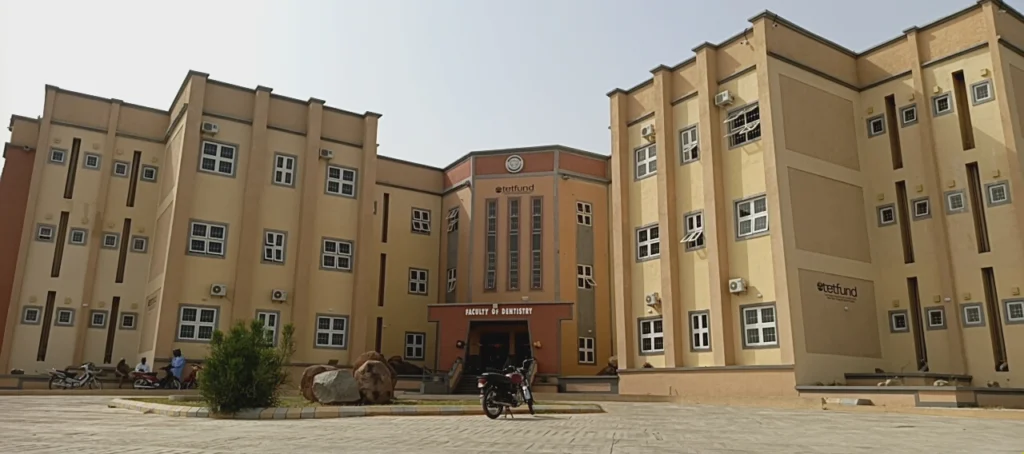
The Executive Secretary, Tertiary Education Trust Fund (TETFund), Sonny Echono, recalled the vision while unveiling 13 projects at FUHSA, Bauchi, recently.

Echono said the initiative was a deliberate national response to the urgent need for more healthcare professionals, stronger medical research capacity and improved resilience in the face of global health challenges.
He explained that the establishment of the institutions was not merely an expansion of the tertiary education system, but a strategic investment in Nigeria’s capacity to train professionals capable of serving the country and contributing to global healthcare.
Echono said Nigeria should intensify investment in training rather than become discouraged by the migration of some professionals abroad.
“What we need to do is to intensify our investment, as we invest to produce more medical and health personnel, some will go out of this country as part of our exports,
“And I can assure you the value of those exports are higher than the natural resources that we are exporting in crude form,” he said.
According to him, the priority should be to produce enough professionals to meet domestic needs while enabling others to contribute to healthcare systems abroad.
FUHSA, established in 2021, commenced academic activities in 2022.
The university was established to train highly skilled health professionals and contribute to medical research and healthcare delivery.
Its rapid development illustrates the level of infrastructure investment required to establish a specialised health sciences institution.
At the commissioning of 13 projects at the university campus, Echono expressed satisfaction with the university’s progress, recalling that he had visited when the idea of establishing the institution was being concretised.
He commended the governing council, Senate, principal officers and particularly the pioneer Vice-Chancellor, Prof. Bala Audu, for their efforts in laying a strong foundation for the university.
He also acknowledged the role of former Minister of Education, Malam Adamu Adamu, whom he described as instrumental in the establishment of the institution.
Echono said the university’s growth demonstrated what purposeful investment, strategic planning and national commitment could achieve in expanding Nigeria’s capacity for medical education.
The unveiling of 13 projects, he added, marked a significant milestone in the development of an institution that had made considerable progress within a few years of establishment.
The projects include modern laboratories, lecture theatres, student hostels, research facilities and other infrastructure designed to support teaching, learning and research.

Echono also disclosed that TETFund had endorsed and recommended contracts for eight medical simulation centres nationwide to the Federal Executive Council, with FUHSA among the beneficiary institutions.
He said implementation was expected to begin in 2026, with equipment installation planned for 2027.
Such facilities are expected to strengthen practical training by enabling students to practise clinical procedures in controlled environments before treating patients.
They are expected to provide an enabling environment for training future doctors, biomedical scientists, nurses, pharmacists and other health professionals.
Audu was upbeat. He said the university had relied heavily on TETFund for infrastructure and equipment since its establishment.
He described one of the facilities as a legacy project conceived at the institution’s inception.
The vice-chancellor said the university required additional support to expand its capacity, particularly through the development of facilities for Basic Medical Sciences and Clinical Sciences.
He explained that medical training required coordinated facilities for basic sciences, clinical education and practical learning.
According to him, further investment in the faculties will enable the university to increase the number of health professionals it produces.
He urged TETFund to consider additional special interventions, noting the Federal Government’s policy to double the country’s capacity for health manpower production.
The university’s Deputy Vice-Chancellor, Administration, Prof. Alkali Mohammed, described the unveiling as a milestone for an institution that had existed for less than five years.
He said the projects would strengthen the university’s capacity to fulfill its mandate of addressing shortages of essential health professionals.
“While the establishment of the six universities represents a significant policy intervention, their long-term success will depend on more than the construction of buildings and provision of equipment.
“Adequate academic staffing, sustainable funding, accreditation, teaching hospitals, research partnerships and access to modern medical technology will be critical to producing competent graduates.
“The institutions must also develop strong links with hospitals and other healthcare providers to ensure that students acquire the practical experience required for professional practice,” he said.
Prof. Samuel Adejare, the Pro-Chancellor and Chairman of FUHSA’s Governing Council, said the university had made significant progress and was the first among the specialised institutions established under the initiative to graduate students.
He commended the university’s management for its achievements but called for additional support, particularly for student accommodation.
Adejare said the university needed a large hostel capable of accommodating about 3,000 students to support its expanding population.
To maximise their impact, the Federal Government must provide Nigeria’s six specialised health universities with sustained funding and institutional support.
While the unveiling of 13 projects at FUHSA marks great progress, all of these institutions need effective management to bridge regional healthcare gaps.
Observers say success will not be measured by the number of universities built, but by their ability to produce skilled professionals, advance medical research, and solve the nation’s critical healthcare shortages.(NANFeatures)
Edited by Chijioke Okoronkwo


Comments