


By Perpetua Onuegbu
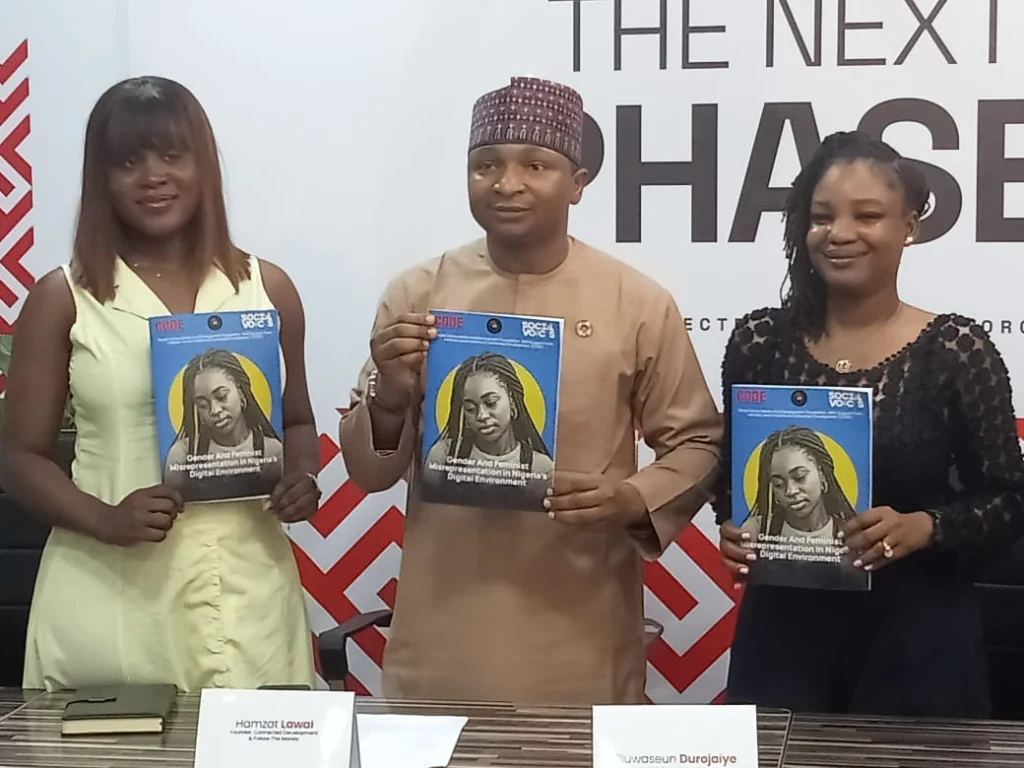
Connected Development (CODE), a Civil Society Organisation (CSO), has announced plans to deploy its citizen-led Uzabe election observation platform nationwide for the 2027 general elections, while unveiling a joint report on digital gender misrepresentation.
The founder of CODE, Hamzat Lawal, said this on Monday in Abuja while unveiling the organisation’s plans for the 2027 elections.
The event was also an opportunity to present the report on Gender and Feminist Misrepresentation in Nigeria’s Digital Environment.
Lawal said the organisation would monitor the presidential and national assembly polls on Jan. 16, 2027, and the governorship and state assembly elections on Feb. 6, 2027, across all 36 states and the Federal Capital Territory(FCT).
“Developed in partnership with Ushahidi, the Uzabe real-time situation room would track permanent voter card collection and campaign conduct,” he said.
Lawal said the situation-room would also track vote buying, Bi-Modal Voter Accreditation System (BVAS) performance, and electronic result transmissions to the INEC Result Viewing Portal (IReV).
He noted that observers would closely document any invocation of Section 60(3) of the Electoral Act 2026, which permitted manual result collation during undefined communication failures.
Lawal added that CODE would share verified evidence of electoral offenses with the Independent National Electoral Commission (INEC) and anti-corruption agencies for prosecution.
He regretted that youth voter registration dropped significantly ahead of the general election, from 39.6 per cent in 2023 to 28.79 per cent in 2026.
”Connected Development is not interested in who emerges as winner; we are interested in how they win.
“I urge young Nigerians to not just vote but audit the promise,” Lawal said.
He reflected on the state of the nation and noted the worsening food insecurity, which he said could place nearly 35 million Nigerians at risk during the lean season amid persistent abductions and opaque security votes.
According to him, macroeconomic gains that do not reach the kitchen table are not yet gains for the poor people.
“A tax system without accountability is not a reform, it is actually a burden for Nigerians.
He called for transparency around the country’s tax regime.
”The historic N68.3 trillion 2026 budget carried N5.71 trillion in unfinished 2025 rollovers, while only 18 per cent of the 2025 capital budget was released by September of 2025.
He also called on local government councils to publish audited accounts following the July 2024 Supreme Court autonomy ruling, alleging that states still diverted funds from the N10.84 trillion allocated to councils even after the judgment.
“Most Nigerians meet government first at the local level; the primary school, the primary health care centre, the road to the market.
“That is why I follow the money taken accountability in the third tiers of government and that is why I call on every council Chairman to publish what their council received and how it is spent,” Lawal said.
Also speaking at the event, founder, Social Voices, Oluwaseun Durojaiye, presented findings from the joint report with CODE, on ‘Gender and Feminism Misrepresentation in Nigeria’s Digital Environment’.
Durojaiye said findings from the report showed that social media algorithms and technology-facilitated gender-based violence were systematically pushing women out of public discourse and the 2027 electoral race.
She noted that while Nigeria’s national assembly currently had only four per cent female representation, public discussions often overlooked the digital and cultural barriers that discouraged women from contesting elections beyond financial constraints.
”There’s a linkage between how women are viewed, how their voices, and how they participate in the digital space, the responses they get, how they are pushed out, and how that translates to when they eventually determine or say, ”Yes, I want to run for office”.
Durojaiye, while extolling the positive impact of Nobel laureate, Maria Ressa, argued that coordinated disinformation eroded the shared reality required for democratic governance.
She warned that societies could not have truth or trust without facts, stressing that online abuse directly fuelled physical political violence and pointed to documented incidents ahead of the 2027 polls.
”It starts from digital spaces, and what happens online becomes offline, so it doesn’t end on social media,” she stated.
She called for strict enforcement of protective laws rather than merely drafting new policies.
Durojaiye said the future of Nigeria depended on the involvement of women, who make up half of the country’s population.(NAN)
Edited by Emmanuel Afonne

Comments