


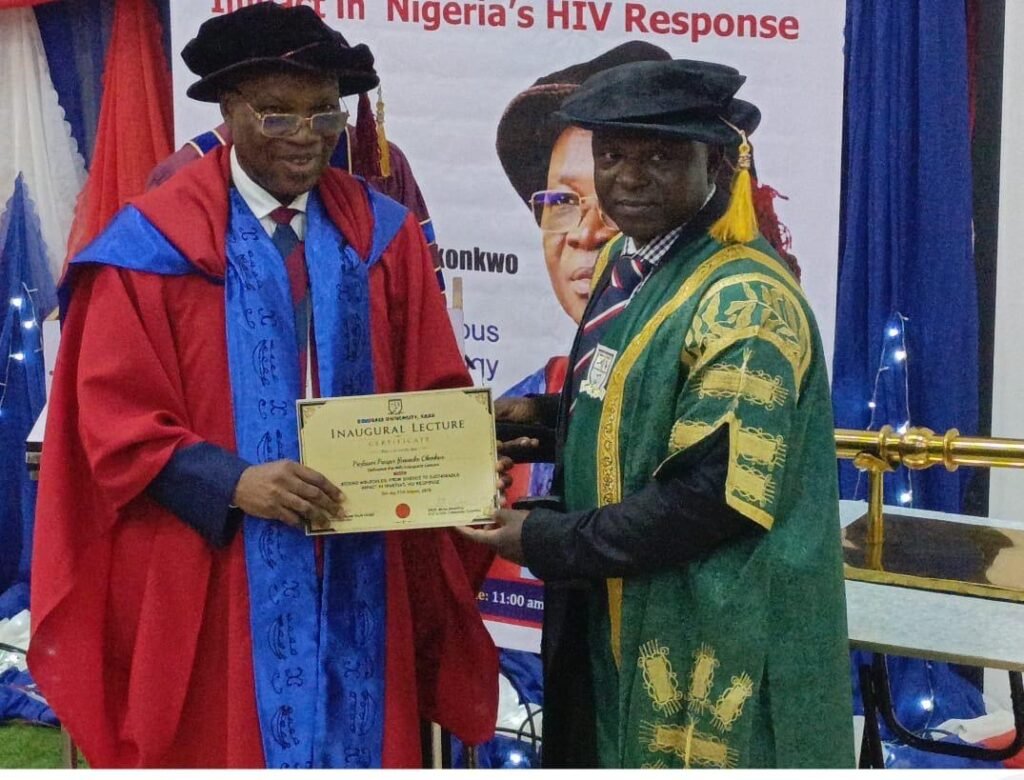
By Folasade Akpan
Prof. Prosper Okonkwo, a public health expert, has called for sustainable domestic financing of Nigeria’s HIV response, protection of its laboratory network and integration of HIV treatment into health insurance.
Okonkwo made the call in his inaugural lecture, titled “Beyond Molecules: From Science to Sustainable Impact in Nigeria’s HIV Response,” at the 14th Bingham University Inaugural Lecture in Nasarawa State.
He said Nigeria’s HIV response had demonstrated that effective science and systems could save lives, but its long-term success would depend on domestic financing, equity, institutional reliability and public trust.
Okonkwo, a Professor of Infectious Disease and Epidemiology in the Department of Community Medicine and Primary Health Care of the university, said Nigeria had expanded HIV treatment significantly.
He said the programme grew from about 15,000 people in its early years to more than 1.78 million by 2023.
He said modern treatment had transformed HIV into a long-term condition that could be managed, noting that people could live long, healthy lives with proper treatment.
He added that people who consistently maintained an undetectable viral load would not transmit HIV through sex.
He, however, said Nigeria’s remaining challenges were increasingly about equity, financing and governance rather than a lack of effective medicines.
“Our remaining challenges are increasingly about equity, financing and governance, rather than a lack of effective medicines,” he said.
The professor said external partners financed between 93 per cent and 96 per cent of Nigeria’s HIV programme between 2019 and 2021, adding that such dependence could not support lasting national ownership.
He called for HIV services to be included in the health insurance benefit package, supported by subsidies and a clear timetable for transitioning to increased domestic financing.
Okonkwo acknowledged recent government measures, including the National Health Compact signed in November 2025 and a N22.68 billion HIV, tuberculosis and malaria co-financing provision in the 2026 budget, but emphasised the need for effective implementation.
“A signed compact is not money released,” he said.
He also urged the Federal Government to formally designate the laboratory network developed for HIV as a national health security asset, noting that the facilities supported Nigeria’s COVID-19 testing response.
“Government should formally designate that network a national health security asset, fund it and govern it as one, so it is there when the next emergency arrives,” he said.
Okonkwo further called for the completion of plans to integrate HIV services into primary healthcare, noting that some facilities already provided HIV care alongside services for hypertension and mental health.
He said Nigeria should sustain its focus on children, with about 160,000 children aged zero to 14 years still living with HIV and requiring continued access to treatment and care.
“In 2023, an estimated 22,000 children acquired HIV, while 15,000 died from AIDS-related causes.
“With appropriate treatment and care during pregnancy and after birth, the chance of passing HIV from a mother to her baby can fall from about 45 per cent to below five per cent,” he said.
He said that prevention of mother-to-child transmission coverage reached 66 per cent in 2024, leaving significant gaps in protecting mothers and babies from HIV infection.
Okonkwo, however, pointed to progress in paediatric treatment, saying coverage among children already diagnosed with HIV rose from about 29 per cent in 2023 to 74 per cent in 2025.
He said the response must also reach people facing the greatest barriers, noting that HIV prevalence among populations most affected by the epidemic was estimated at between eight and 21 times higher.
He said the figure was compared with the 2018 national average HIV prevalence of 1.4 per cent.
“These are often people who face stigma, discrimination, criminalisation or other barriers that make it difficult to seek prevention, testing and care safely,” he said.
He said moving services closer to people was important, but care must also be built around trust, as some patients still faced transport costs, fear of disclosure, breaches of confidentiality and mental health challenges.
Okonkwo said uninterrupted access to medicines, consistent adherence and regular viral-load testing were also necessary for people receiving treatment to achieve and maintain viral suppression.
“The question before us is no longer whether we know what works, but whether we are prepared to govern success with the same seriousness that once drove emergency action,” he said.
The Director-General of the National Agency for the Control of AIDS, Dr Temitope Ilori, described the lecture as an exercise in implementation and translational science, highlighting its relevance to Nigeria’s HIV response.
Ilori said it demonstrated the importance of working closely with government and policymakers to generate local evidence capable of guiding policies and improving patient outcomes.
The Vice-Chancellor, University of Lagos, Prof. Folasade Ogunsola, said the lecture demonstrated the importance of evidence-based scholarship and its role in moving the country forward.
“His lecture was anchored on evidence, showing the translation of evidence into practical action and impact, while the recommendations were clearly based on lessons learned.”(NAN)
Edited by Abiemwense Moru



Comments